
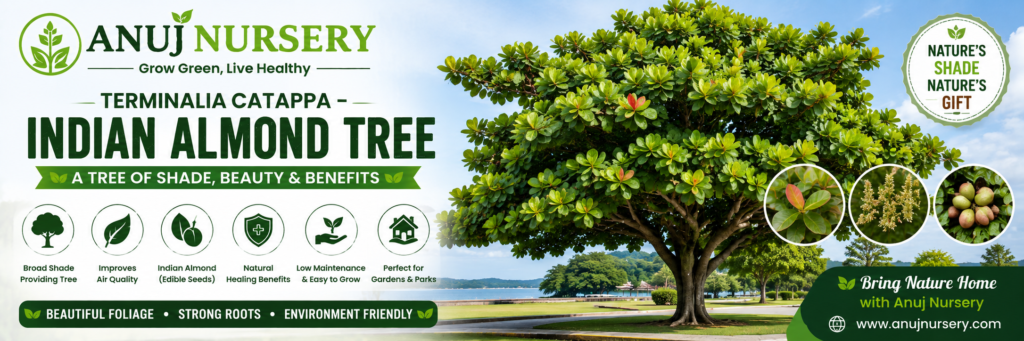
The Indian Almond Tree, scientifically known as Terminalia catappa, is a beautiful tropical and subtropical tree appreciated for its broad, attractive leaves, spreading growth habit, and distinctive appearance. It can be an excellent choice for spacious gardens, landscapes, parks, farmhouses, and other outdoor areas where sufficient room is available for long-term growth.
If you are looking for information about Indian Almond Tree care and benefits, this complete guide from Anuj Nursery will help you understand its basic growing requirements, watering needs, sunlight preferences, soil conditions, uses, and important planting considerations.
Looking to add a beautiful Indian Almond Tree to your landscape? Explore Terminalia catappa from Anuj Nursery today!
What Is the Indian Almond Tree?
The Indian Almond Tree, or Terminalia catappa, is a large tree known for its broad leaves and distinctive branching structure. It can develop a wide, spreading crown and may become a substantial landscape tree when grown under suitable conditions.
Its attractive form makes it popular for ornamental and landscape planting. In suitable climates, it can provide shade and contribute to the overall visual appeal of gardens and outdoor spaces.
Because Terminalia catappa can become a large tree, selecting an appropriate planting location is very important.
Indian Almond Tree Benefits
The Indian Almond Tree offers several practical and ornamental benefits when planted in a suitable location.
1. Attractive Landscape Tree
Terminalia catappa has a distinctive branching structure and broad foliage that can create an attractive visual feature in spacious outdoor landscapes.
2. Provides Shade
As the tree matures and develops a broad canopy, it can provide shade in suitable outdoor areas. This makes it useful for large gardens, open landscapes, and other spacious properties.
3. Beautiful Foliage
The large leaves are one of the tree’s most recognizable features. Under suitable seasonal conditions, the foliage can add considerable visual interest to the landscape.
4. Suitable for Large Gardens
If you have sufficient outdoor space, Indian Almond Tree can be considered for gardens, farmhouses, parks, institutional landscapes, and other large properties.
5. Adds Natural Beauty
A mature Terminalia catappa can become a strong focal point in a landscape and can be combined with other trees, shrubs, flowering plants, and garden features.
6. Long-Term Landscape Value
When planted in an appropriate location and cared for properly, the tree can become a long-term part of a landscape.
Important: The tree can become large, so always consider its mature size before planting near buildings, roads, utility lines, walls, or other structures.
Indian Almond Tree Care Guide
Proper care during establishment can help your Terminalia catappa develop successfully.
Sunlight
Indian Almond Tree generally prefers a bright outdoor location with plenty of sunlight. Choose an open area where the developing tree can receive adequate light throughout the day.
Soil
Terminalia catappa can grow in a range of soil conditions, but good drainage is important. Avoid locations where water remains stagnant for long periods.
A suitable soil structure with adequate drainage can support healthier root development.
Watering
Young Indian Almond Trees may require regular watering while they become established. Watering requirements depend on rainfall, soil type, temperature, season, and local climate.
Avoid excessive watering and continuously waterlogged soil.
Once established, watering needs may be different from those of a newly planted tree.
Fertilization
A suitable fertilizer or organic soil amendment can be used when necessary according to the plant’s requirements and product instructions.
Avoid excessive fertilizer application. Soil condition and plant growth should be considered when planning a feeding routine.
Pruning
Pruning can help manage unwanted or damaged branches and maintain an appropriate tree structure. Remove dead, damaged, or poorly positioned branches using proper pruning practices.
For large mature trees, professional assistance may be appropriate.
How to Grow Indian Almond Tree
Growing Terminalia catappa successfully starts with selecting the right location.
Step 1: Choose a spacious location.
Select an area with sufficient room for the tree’s future canopy and root system.
Step 2: Check sunlight.
Choose an outdoor location with adequate sunlight.
Step 3: Prepare the soil.
Ensure the planting area has suitable soil and good drainage.
Step 4: Plant carefully.
Place the tree at an appropriate depth without unnecessarily burying the trunk.
Step 5: Water after planting.
Provide suitable water to help the tree establish.
Step 6: Maintain the area.
Keep competing weeds and unwanted vegetation away from the immediate planting area.
Step 7: Monitor growth.
Observe the tree regularly for signs of stress, pests, diseases, or nutrient problems.
Is Indian Almond Tree Suitable for Home Gardens?
Yes, but the available space is an important consideration.
Terminalia catappa can become a large tree with a spreading canopy. Therefore, it may be more appropriate for large home gardens, farmhouses, estates, parks, and spacious landscapes than for very small residential gardens.
Before planting, make sure there is enough distance from buildings, boundary walls, electrical wires, pathways, and other structures.
If you have a small garden, consider a plant or tree with a naturally smaller mature size.
The Indian almond tree is a hardy, fast-growing tree known for its broad canopy, colorful seasonal leaves, and cooling shade. It thrives in tropical and coastal regions with full sunlight and well-drained soil. The Indian almond tree also supports wildlife, improves air quality, and adds natural beauty to gardens, parks, and landscapes.
Indian Almond Tree in Nagal & Saharanpur
If you are searching for an Indian Almond Tree in Nagal or Saharanpur, local growing conditions should be considered when selecting and planting Terminalia catappa.
Anuj Nursery can help plant lovers explore trees and gardening products for different outdoor spaces.
Whether you are planning a home landscape, farmhouse garden, commercial property, or larger plantation project, select the tree according to your available space and long-term landscape requirements.
Looking for Terminalia catappa in Nagal or Saharanpur? Explore Anuj Nursery today!
👉 Visit Anuj Nursery – anujnursery.in
Why Choose Anuj Nursery?
At Anuj Nursery, we aim to make plant shopping convenient for garden lovers and landscaping enthusiasts.
Whether you are looking for ornamental plants, flowering plants, trees, gardening products, fertilizers, or growing materials, choosing the right plant for your space is an important first step.
For a large tree like Terminalia catappa, consider the plant’s expected mature size and your available planting area before ordering.
Ready to add an Indian Almond Tree to your garden or landscape? Explore Anuj Nursery today!
Order Indian Almond Tree from Anuj Nursery
The Terminalia catappa – Indian Almond Tree can be a beautiful choice for spacious outdoor landscapes. Its broad foliage, spreading form, and attractive structure can create a strong natural presence in gardens and other suitable outdoor spaces.
If you have enough room for a large tree and want to add long-term greenery to your landscape, Indian Almond Tree is worth considering.
👉 Explore Indian Almond Tree at Anuj Nursery
Order your Indian Almond Tree from Anuj Nursery today and start creating a greener, more beautiful outdoor space!
Frequently Asked Questions About Indian Almond Tree
What is the scientific name of Indian Almond Tree?
The scientific name of the Indian Almond Tree is Terminalia catappa.
What are the main benefits of Indian Almond Tree?
Indian Almond Tree is valued for its attractive appearance, broad foliage, shade potential, and suitability for spacious gardens and landscapes.
How much sunlight does Terminalia catappa need?
Indian Almond Tree generally performs well in bright outdoor conditions with sufficient sunlight.
How often should I water Indian Almond Tree?
Watering depends on the tree’s age, soil, rainfall, temperature, season, and local conditions. Newly planted trees generally require more attention during establishment than established trees.
Can Indian Almond Tree grow in a home garden?
Yes, if the garden has sufficient space. Because Terminalia catappa can become a large tree, it should not be planted too close to buildings or other structures.
Is Terminalia catappa suitable for landscaping?
Yes. Its broad canopy and distinctive growth habit can make it an attractive option for spacious landscape projects.
Where can I buy Indian Almond Tree in India?
You can explore and buy Indian Almond Tree from Anuj Nursery for suitable garden and landscaping applications.
Grow a Beautiful Indian Almond Tree with Anuj Nursery
The Indian Almond Tree, Terminalia catappa, can bring impressive greenery and natural character to a spacious outdoor landscape. With suitable sunlight, soil, watering, space, and regular care, it can become a valuable long-term feature of your garden.
If you are planning a new landscape in Nagal, Saharanpur, or elsewhere in India, choose your planting location carefully and give this beautiful tree enough room to grow.
Ready to add Terminalia catappa to your landscape? Get started with Anuj Nursery today!