
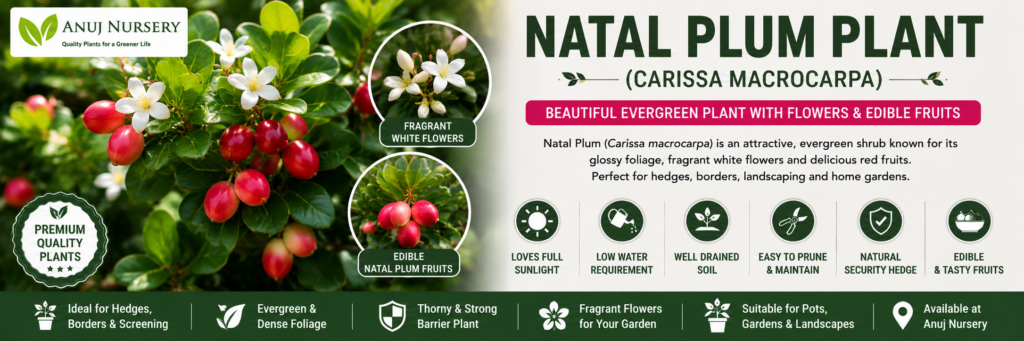
The Natal Plum Plant (Carissa macrocarpa) is an attractive evergreen shrub known for its glossy green foliage, fragrant white star-shaped flowers, red edible fruits and naturally thorny branches. Native to the coastal regions of South Africa, this versatile plant has become popular in warm-climate landscaping because it combines ornamental beauty with practical uses such as hedging, screening and boundary planting.
For Indian gardens, the Natal Plum can be an interesting choice for homeowners, landscapers, farmhouses and commercial properties looking for a dense, low-maintenance ornamental plant. Its evergreen foliage provides year-round greenery, while its flowers and colorful fruits add seasonal interest.
What Is Carissa macrocarpa?
Carissa macrocarpa belongs to the Apocynaceae family and is commonly known as Natal Plum or Large Num-Num. It is an evergreen, densely branched shrub with thick, leathery, glossy green leaves. The plant produces fragrant white flowers followed by oval fruits that mature from green to red or reddish-purple.
One feature that makes Natal Plum particularly useful for landscaping is its strong forked thorns. These can make it an effective natural barrier or privacy hedge, but they also mean the plant should be positioned carefully away from high-traffic areas and children’s play spaces.
Why Choose a Natal Plum Plant?
The Natal Plum offers more than attractive foliage. It can perform several jobs in a landscape:
- Evergreen ornamental shrub
- Privacy hedge
- Boundary planting
- Security barrier
- Foundation planting
- Container plant
- Groundcover with selected cultivars
- Fruit-producing ornamental plant
- Coastal and salt-tolerant landscaping
Its dense branching and ability to tolerate pruning make it particularly useful for formal or informal hedges.
Natal Plum Plant Care
1. Sunlight
Carissa macrocarpa performs well in full sun to light shade, although strong sunlight generally supports dense, attractive growth and flowering. Choose an open location with good natural light for the best landscape performance.
If a nursery-grown plant has been kept under shade, gradually acclimatize it before exposing it to intense direct sunlight.
2. Watering
Natal Plum is relatively drought tolerant once established, but newly planted specimens need regular watering while their roots develop. The exact frequency depends on temperature, rainfall and soil type.
Avoid keeping the root zone continuously waterlogged. Good drainage is especially important because poorly drained soil can cause root problems.
3. Soil
Natal Plum is adaptable to different soil types, including sandy, loamy and somewhat alkaline soils, provided drainage is good. It performs particularly well in well-drained soil.
If your garden soil retains excessive water, improve drainage before planting rather than trying to solve the problem through frequent maintenance later.
Flowers and Natal Plum Fruit
One of the most attractive characteristics of Carissa macrocarpa is its combination of flowers and fruit. The plant produces fragrant white, five-petaled, star-shaped flowers. These are followed by oval fruits that change from green to red or purple as they mature.
The ripe fruit is edible and can be eaten fresh or used in products such as jams and jellies. However, only properly identified and fully ripe fruit should be consumed, and gardeners should not assume that every plant sold under a similar common name is the same species.
Pruning and Hedge Maintenance
Regular pruning can help maintain a compact and attractive shape. Natal Plum responds well to shearing and can be trained as a hedge or screen.
Because the plant has substantial thorns, wear protective gloves and suitable clothing while pruning. Avoid planting it directly beside narrow walkways where people may frequently brush against the branches.
For a formal hedge, consistent light pruning is generally better than allowing the plant to become excessively large and then making severe cuts.
Natal Plum for Indian Landscaping
The Natal Plum Plant can be particularly useful in warm Indian landscapes where an evergreen, dense and drought-tolerant shrub is desired. Its ability to tolerate salt exposure also makes it valuable in appropriate coastal landscapes.
For areas such as Saharanpur and other parts of Uttar Pradesh, gardeners should consider winter temperatures, sunlight and drainage before planting. Natal Plum is a warm-climate plant and is best suited to locations where severe frost is not a regular problem.
For boundary planting, maintain sufficient distance from paths, entrances and children’s areas because of its thorns.
Buy Natal Plum Plant from Anuj Nursery
If you are searching for a Natal Plum Plant, Carissa macrocarpa or ornamental hedge plant in India, Anuj Nursery can be considered for fruit, ornamental and landscaping plant requirements.
Before buying, don’t judge a nursery plant only by its height. Check:
- Healthy green foliage
- Strong branching
- Good root development
- No obvious pest or disease damage
- Correct botanical identification
- Desired plant form
- Suitable size for your planting location
For landscaping projects, also plan the spacing before purchasing multiple plants. A dense hedge requires room for plants to establish and develop naturally.
Frequently Asked Questions
What is the botanical name of Natal Plum?
The botanical name of Natal Plum is Carissa macrocarpa.
Is Natal Plum a fruit plant?
Yes. Carissa macrocarpa produces oval red to reddish-purple fruits that are edible when ripe.
Is Natal Plum good for hedges?
Yes. Its dense growth and thorny branches make it an effective hedge and privacy or security barrier.
Does Natal Plum need full sunlight?
It can grow in full sun to light shade, with good sunlight generally supporting strong ornamental growth.
Is Natal Plum drought tolerant?
Yes. Established plants have good drought tolerance, although newly planted specimens require appropriate irrigation until they establish.
Is Natal Plum suitable for pots?
Yes, suitable cultivars can be grown in containers. Container plants require good drainage and regular monitoring of moisture and nutrition.
Final Thoughts
The Natal Plum Plant (Carissa macrocarpa) is a versatile evergreen shrub that combines glossy foliage, fragrant white flowers, colorful edible fruit and strong hedge-forming ability. Its drought and salt tolerance further increase its value for suitable landscapes.
For the best results, provide good sunlight, well-drained soil, sensible watering and regular pruning. Most importantly, remember that the plant’s thorns are both its advantage and its limitation: they make an excellent barrier, but placement matters.
If you’re planning a garden, boundary hedge or ornamental landscape in a suitable warm climate, Carissa macrocarpa is a plant worth considering for both beauty and function.