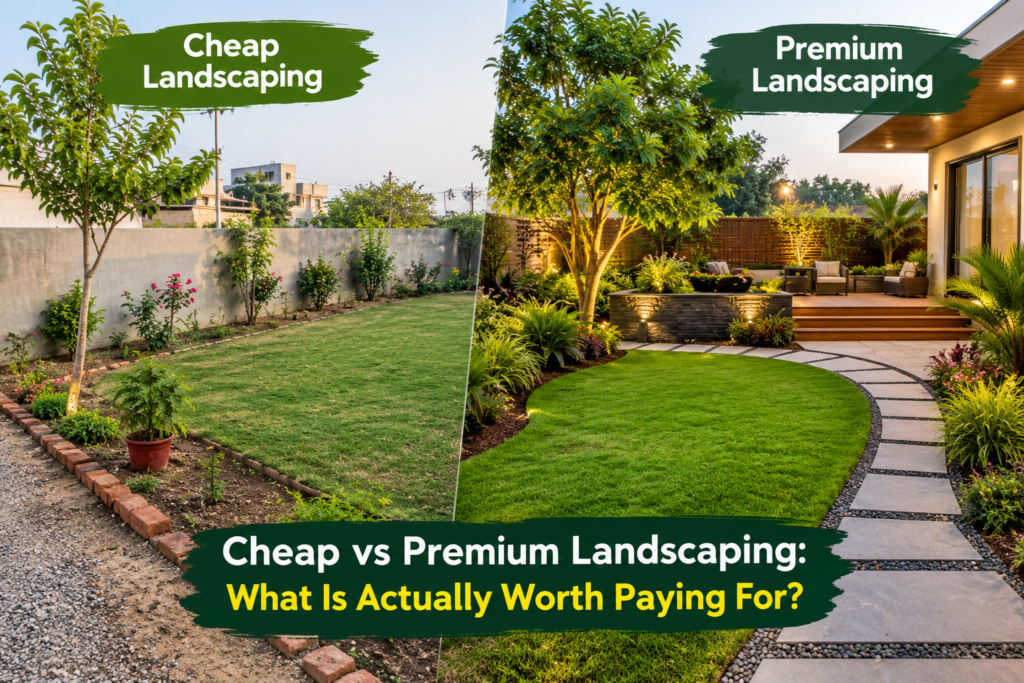
Landscaping can completely change the look, comfort, and value of an outdoor space. But when planning a garden or landscape project, one common question comes up: Should you choose cheap landscaping or invest in premium landscaping?
The answer depends on where your money goes. Some landscaping features are worth paying more for because they affect long-term durability, plant health, maintenance, and overall appearance. At the same time, there are areas where you can save money without sacrificing quality.
In this guide, we compare cheap vs premium landscaping and explain what is actually worth investing in.
What Does Cheap Landscaping Usually Mean?
Cheap landscaping does not always mean poor landscaping. A budget-friendly landscape can still look attractive when it is planned carefully.
Cost-saving landscaping may involve:
- Smaller plants instead of mature specimens
- Locally available plant varieties
- Simple garden layouts
- Affordable paving materials
- Basic irrigation systems
- Fewer decorative elements
- DIY planting and maintenance
The biggest advantage is the lower initial investment. However, choosing the cheapest option for every part of a project can sometimes increase maintenance and replacement costs later.
What Is Premium Landscaping?
Premium landscaping focuses on higher-quality materials, thoughtful design, better plant selection, professional installation, and long-term performance.
Premium projects may include:
- Mature and carefully selected plants
- Professional landscape design
- High-quality paving and outdoor materials
- Efficient irrigation systems
- Proper soil preparation
- Landscape lighting
- Feature plants and trees
- Professional drainage solutions
- Regular garden maintenance
The initial cost can be higher, but certain premium features can provide better durability and reduce future problems.
Where Is It Worth Paying More?
1. Quality Plants and Trees
Plants are one of the most important parts of landscaping. Buying extremely cheap plants may save money initially, but unhealthy or poorly developed plants can struggle after planting.
Investing in healthy nursery-grown plants with strong root systems can improve establishment and long-term growth.
For large landscaping projects, selecting the right plant species for the local climate, soil, sunlight, and available space is especially important.
2. Soil Preparation
Soil preparation is often overlooked because it is not visually impressive. However, it directly affects plant performance.
Good soil preparation may include:
- Removing unwanted debris
- Improving soil structure
- Adding suitable organic matter
- Correcting drainage issues
- Preparing proper planting pits
Saving money by skipping essential soil preparation can result in weak growth, waterlogging, or repeated plant replacement.
3. Irrigation System
An irrigation system is another area where quality matters.
A very basic irrigation setup may work for a small garden, but larger landscapes can benefit from efficient drip irrigation, sprinklers, timers, and properly designed watering zones.
A well-planned irrigation system can help deliver water more efficiently and make routine garden care easier.
4. Drainage
Drainage is one feature where cutting costs can create expensive problems.
Poor drainage can lead to standing water, root problems, soil erosion, and damage to landscape surfaces.
If your property has drainage challenges, investing in proper grading and drainage solutions can be more valuable than spending heavily on decorative features.
Where Can You Save Money?
5. Decorative Features
You do not always need expensive fountains, sculptures, premium tiles, or elaborate structures to create an attractive landscape.
Simple elements such as:
- Gravel paths
- Natural stones
- Mulch
- Basic planters
- Low-cost garden borders
can create a clean appearance without significantly increasing the project budget.
6. Plant Size
Buying mature trees can provide an immediate visual impact, but smaller healthy plants can be a practical option when you have time to wait for growth.
For residential gardens, choosing a mixture of smaller plants and a few strategically placed feature trees can help balance cost and appearance.
7. Complex Garden Design
A complicated landscape design is not automatically better.
A simple layout with clear pathways, suitable plants, open spaces, and practical maintenance zones can look beautiful while keeping costs under control.
The goal should be to create a landscape that works well for the property rather than simply adding more features.
Cheap vs Premium Landscaping: A Smart Comparison
The best approach is usually not to make everything cheap or everything premium. Instead, divide your budget according to importance.
Spend more on:
- Healthy plants and trees
- Soil preparation
- Drainage
- Irrigation
- Quality installation
- Durable high-use surfaces
Save money on:
- Excessive decorations
- Unnecessary structures
- Oversized planters
- Overly complicated designs
- Features that require frequent maintenance
This strategy can create a landscape that looks premium without requiring a premium budget for every component.
How to Create a Premium Look on a Budget
You can achieve an expensive-looking landscape through good planning rather than expensive materials alone.
Use repetition of similar plants, maintain clean edges, create balanced planting beds, and keep pathways properly defined. Choose plants that naturally suit your area’s climate and require manageable maintenance.
A few well-positioned trees can also have a greater visual impact than filling the garden with many unrelated plants.
For homeowners and businesses, working with a reliable nursery and landscape professional can also help avoid poor plant selection and unnecessary replacement costs.
Final Thoughts
When comparing cheap vs premium landscaping, the most important factor is not simply the price. It is the long-term value of each investment.
Spending more on plant quality, soil preparation, drainage, irrigation, and durable materials can make sense because these elements directly affect landscape performance. On the other hand, decorative features and complicated designs can often be simplified without reducing the overall beauty of the space.
A successful landscape is one that combines quality, functionality, appearance, and manageable maintenance. With the right priorities, you can create an attractive outdoor space while keeping your landscaping budget under control.