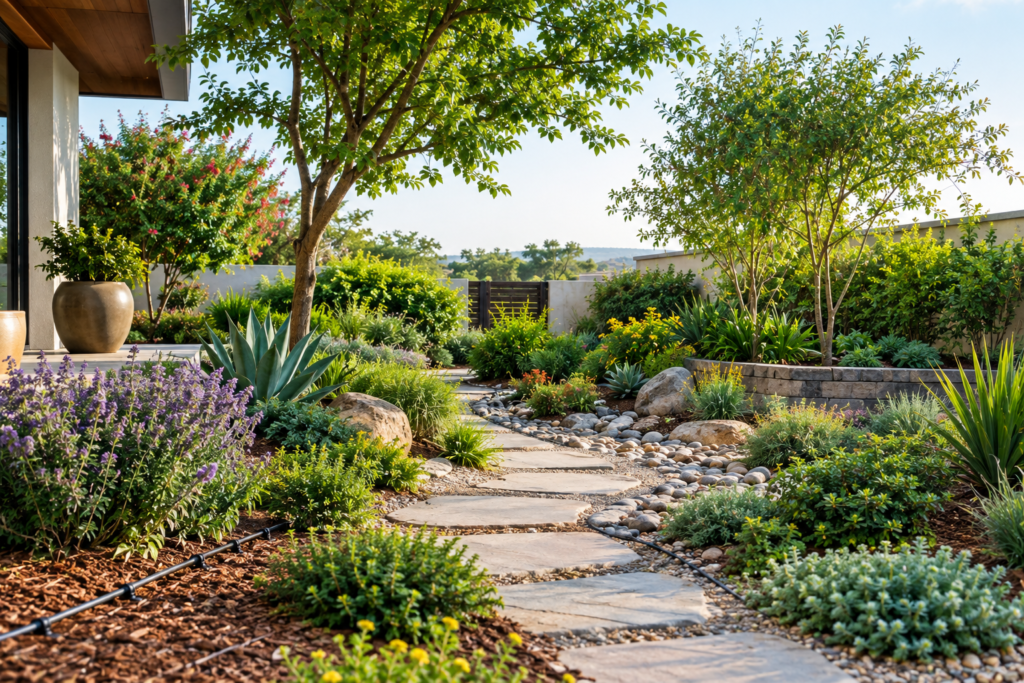
A beautiful landscape does not have to require constant watering, pruning, fertilizing, mowing, and pest control. Lower-input landscapes are designed to remain attractive and healthy while requiring fewer resources and less regular maintenance. The key is not to eliminate maintenance completely, but to design the landscape intelligently from the beginning.
For homeowners, commercial property owners, builders, and developers, lower-input landscaping can reduce ongoing maintenance while creating a more practical and environmentally responsible outdoor space. Anuj Nursery can help homeowners and landscaping professionals explore suitable plants for residential, commercial, and garden projects.
What Is a Lower-Input Landscape?
A lower-input landscape is an outdoor space designed to reduce the amount of water, fertilizer, pesticides, labor, energy, and other resources needed for long-term maintenance.
Instead of choosing plants simply because they look attractive at the nursery, lower-input landscape design considers their mature size, climate adaptability, water requirements, soil preferences, sunlight needs, and maintenance demands.
The result is a landscape that works with its environment instead of constantly requiring correction.
1. Start With a Site Assessment
Before selecting plants, understand the site.
Observe how much sunlight different areas receive during the day. Check drainage, soil condition, existing vegetation, wind exposure, slopes, and areas where water naturally collects.
Also consider how people will use the space. A garden beside a driveway may need durable plants, while a shaded seating area may require completely different vegetation.
A proper site assessment helps prevent one of the biggest landscaping mistakes: choosing plants first and trying to adapt the site afterward.
2. Choose Climate-Appropriate Plants
Plant selection is the foundation of a lower-input landscape. Plants that are well suited to the local climate generally require less intervention once established.
Consider native, locally adapted, and drought-tolerant plants where appropriate. Select trees, shrubs, palms, flowering plants, and ground covers according to their sunlight and water requirements.
For landscapes in India, plant selection should account for seasonal heat, monsoon rainfall, winter temperatures, soil conditions, and available irrigation.
Anuj Nursery offers a variety of plants that can be considered for different landscaping requirements, including residential gardens and larger landscape projects.
3. Group Plants According to Their Needs
Avoid placing plants with completely different water requirements in the same planting bed.
Instead, create planting zones. Plants with similar irrigation needs can be grouped together, while plants requiring more moisture can be placed closer to reliable water sources.
This approach, often called hydrozoning, makes irrigation more efficient and can prevent both overwatering and underwatering.
It also makes maintenance easier because each planting area can follow a more consistent care routine.
4. Improve the Soil Before Planting
Healthy soil can reduce many problems later.
Before planting, check whether the soil is compacted, poorly drained, excessively sandy, or lacking organic matter. Improve the soil according to the actual site condition rather than applying products unnecessarily.
Organic matter such as suitable compost can improve soil structure and moisture retention. Mulching around plants can further reduce evaporation, suppress weeds, and protect the soil surface.
However, mulch should be applied correctly and kept away from direct contact with tree trunks and plant stems.
5. Design an Efficient Irrigation System
Water management is one of the most important elements of lower-input landscaping.
Drip irrigation and other targeted irrigation systems can deliver water closer to plant root zones. Watering should be adjusted according to season, rainfall, plant maturity, and soil moisture.
Avoid automatically watering every area for the same amount of time. Different plants and landscape zones may have very different water requirements.
Rainwater collection can also complement landscape irrigation where practical and permitted.
6. Reduce High-Maintenance Lawn Areas
Lawns can provide useful open space, but large lawn areas may require regular mowing, irrigation, fertilization, and weed management.
Consider using lawn only where it serves a clear purpose, such as recreation or circulation. Other areas can incorporate trees, shrubs, ground covers, planting beds, mulch, or suitable hardscape.
The goal is not to remove every lawn area. It is to make sure every part of the landscape has a practical purpose.
7. Plan for Mature Plant Size
A plant that looks small at installation can become a major maintenance problem if there is not enough room for its mature growth.
Before planting, consider the expected height, canopy spread, root development, and distance from buildings, walls, pathways, utility lines, and other plants.
Correct spacing reduces unnecessary pruning and prevents overcrowding. It can also improve air circulation and sunlight penetration.
Good landscape design considers what the garden will look like several years from now—not just on installation day.
8. Encourage Natural Biodiversity
A diverse landscape can provide habitat and food sources for birds, butterflies, bees, and other beneficial organisms.
Use a thoughtful mixture of trees, shrubs, flowering plants, and ground covers rather than creating a landscape dominated by a single plant species.
Reducing unnecessary pesticide use can also support beneficial insects and contribute to a healthier garden ecosystem.
9. Choose Durable Materials
Lower-input landscaping is not limited to plants.
Paths, edging, patios, seating areas, drainage features, and other hardscape elements should be designed for durability and practical use. Durable materials can reduce frequent repairs and replacements.
Permeable surfaces can also help manage rainwater runoff where suitable for the site.
10. Think About Maintenance Before Installation
The most important question is simple: Who will maintain the landscape, and how much time and money are available for maintenance?
A landscape requiring daily attention may not be practical for a busy homeowner or commercial property. Select plants and design features according to realistic maintenance capacity.
A slightly simpler landscape that remains healthy with routine care can be more successful than an elaborate garden that becomes neglected.
Conclusion
Designing a lower-input landscape starts with smart decisions rather than expensive solutions. Assess the site, choose suitable plants, improve soil, manage water efficiently, reduce unnecessary lawn, plan for mature plant growth, support biodiversity, and select durable materials.
The objective is not a maintenance-free garden. The objective is a landscape that needs less intervention because it has been designed correctly.
Whether you are planning a home garden, commercial property, institutional landscape, or large development project, thoughtful plant selection and site planning can make long-term maintenance more manageable. Anuj Nursery can be a useful source for exploring plants suitable for a wide range of landscaping applications.