Choosing plants for a garden is not simply about selecting the most attractive flowers, trees, or shrubs. A plant can look beautiful at a nursery but struggle after planting if the garden does not provide the conditions it needs.
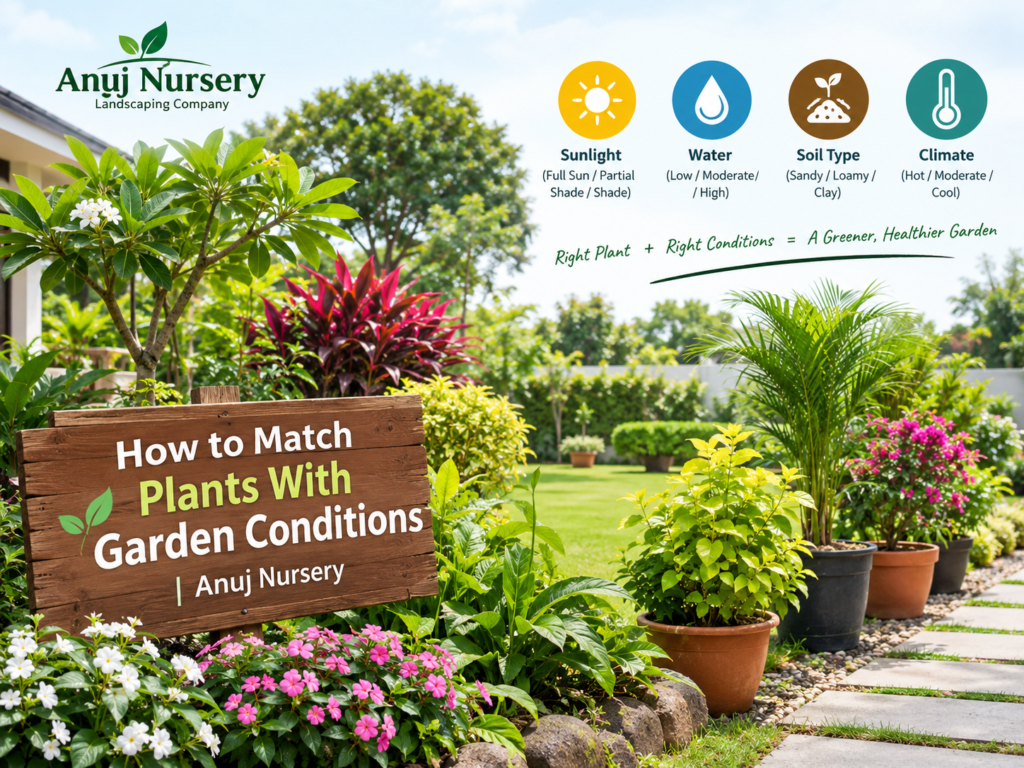
Learning how to match plants with garden conditions helps homeowners choose healthier plants, reduce replacement costs, and create landscapes that are easier to maintain. Before buying plants, evaluate sunlight, soil, water, drainage, temperature, available space, and maintenance requirements.
1. Start With Sunlight
Sunlight is one of the most important factors in plant selection.
Observe how much direct sunlight different areas of your garden receive during the day. Some locations may receive full sun, while areas near walls or buildings may receive partial shade or mostly shade.
Generally, plants can be grouped according to their light requirements:
- Full-sun plants: Require several hours of direct sunlight.
- Partial-sun plants: Prefer some direct sunlight with periods of shade.
- Shade-tolerant plants: Can grow with limited direct sunlight.
Do not assume that every part of your garden receives the same amount of light. Assess each planting zone separately.
2. Understand Your Soil
Soil affects root development, water availability, and nutrient uptake.
Before planting, check whether your soil is sandy, clay-heavy, loamy, compacted, or rich in organic matter. Very compacted soil can restrict root growth, while poorly draining soil may cause water to remain around roots for too long.
Improving soil structure with suitable organic matter and proper preparation can help plants establish more successfully.
3. Check Soil Drainage
Drainage is particularly important for trees, shrubs, flowering plants, and ornamental plants.
If water remains on the surface after irrigation or rainfall, the area may have drainage problems. Plants that require well-drained soil may struggle in such locations.
For areas with poor drainage, consider improving the soil, correcting the landscape grade, or selecting plants that tolerate wetter conditions.
4. Match Plants With Water Availability
Different plants have different water requirements.
Before selecting plants, determine how much water is realistically available for garden maintenance. A plant that requires frequent watering may not be suitable for a location where irrigation is limited.
Grouping plants with similar water requirements can also make irrigation more efficient.
For example, drought-tolerant plants can be placed together instead of mixing them with plants that require consistently moist soil.
5. Consider Your Local Climate
Climate affects plant growth throughout the year. Temperature, rainfall, humidity, seasonal changes, and extreme weather can influence plant performance.
For gardens in Saharanpur and other parts of North India, plant selection should take local seasonal conditions into account.
A plant suitable for one region may require additional care in another. Therefore, local growing conditions should be considered before purchasing plants.
6. Consider the Mature Size of Plants
One of the most common garden planning mistakes is selecting plants based only on their current nursery size.
A small tree can eventually develop a large canopy. Similarly, a compact shrub may spread considerably after several years.
Before planting, consider:
- Mature height
- Mature width
- Root growth
- Canopy spread
- Distance from buildings
- Distance from pathways
- Distance from walls and utilities
Correct spacing creates a healthier and more manageable landscape.
7. Match Plants With the Purpose of the Garden
Your garden’s purpose should influence plant selection.
For example:
For shade: Choose suitable trees with appropriate canopy characteristics.
For privacy: Consider dense shrubs, hedges, or suitable screening plants.
For colour: Use flowering plants and ornamental foliage.
For boundaries: Select plants that can create structure without becoming difficult to control.
For low-maintenance areas: Consider durable plants that match local conditions and require less intensive care.
A clear purpose makes plant selection much easier.
8. Consider Maintenance Requirements
Every garden has a maintenance cost in terms of time, water, labour, and materials.
Before choosing a plant, ask:
- How often does it need watering?
- Does it require regular pruning?
- Does it shed leaves or flowers heavily?
- Is it vulnerable to common pests?
- Does it require seasonal care?
- How quickly does it grow?
A plant may be suitable for your soil and sunlight but still be inappropriate if its maintenance requirements do not match your available time or resources.
9. Group Plants With Similar Requirements
A practical landscape design groups plants according to their needs.
For example, plants requiring full sun can be grouped together, while shade-tolerant plants can occupy shaded areas. Similarly, plants with similar water requirements can share an irrigation zone.
This approach can simplify watering, fertilization, pruning, and general garden maintenance.
10. Buy Plants From a Reliable Nursery
Plant quality also matters. Healthy nursery plants generally have a better starting point for establishment after transplantation.
When purchasing plants, check for:
- Healthy foliage
- Strong stems
- Well-developed roots
- Appropriate plant size
- Signs of pests or disease
- Proper nursery care
Anuj Nursery can help homeowners in Saharanpur and surrounding areas explore plants for different residential landscaping requirements and garden conditions.
Conclusion
Learning how to match plants with garden conditions is one of the foundations of successful landscape planning. Instead of choosing plants based only on appearance, evaluate sunlight, soil, drainage, water availability, climate, mature size, purpose, and maintenance requirements.
The right plant in the right location is usually easier to establish and maintain. By assessing each garden area before purchasing plants, homeowners can create healthier, more practical, and attractive landscapes.
For homeowners planning gardens in Saharanpur, Anuj Nursery can be a useful local source for exploring plants suitable for different landscape applications.
AEO Optimization
How do I match plants with garden conditions?
Match plants with a garden by evaluating sunlight, soil type, drainage, water availability, climate, available space, mature plant size, and maintenance requirements before planting.
What is the most important factor when choosing plants?
There is no single factor that works for every garden. Sunlight, soil, water, drainage, climate, and plant maturity should be considered together.
How does sunlight affect plant selection?
Sunlight determines which plants can grow successfully in a particular location. Full-sun plants generally need more direct light, while shade-tolerant plants can grow with less direct sunlight.
Why should plants be grouped according to their needs?
Grouping plants with similar sunlight and water requirements can simplify irrigation and maintenance while creating more suitable growing conditions.
Can the same plants be used throughout a garden?
Not always. Different parts of a garden can have different levels of sunlight, moisture, soil conditions, and available space, so plant selection should be based on the conditions of each planting area.
GEO Optimization
Primary Local Keyword: How to Match Plants With Garden Conditions in Saharanpur
Supporting Local Keywords:
- Plant Selection in Saharanpur
- Best Plants for Gardens in Saharanpur
- Garden Plants in Saharanpur
- Plants for Residential Landscaping in Saharanpur
- Plant Nursery in Saharanpur
- Garden Planning in Saharanpur
- Landscape Plants in Saharanpur
Suggested Internal Links:
- Garden Microclimates Before Plant Selection
- How to Choose Ornamental Trees
- Garden Planning Checklist for Homeowners
- How to Measure a Garden Before Planting
- Garden Planning for Small Plots
- Residential Landscape Planning for New Homes