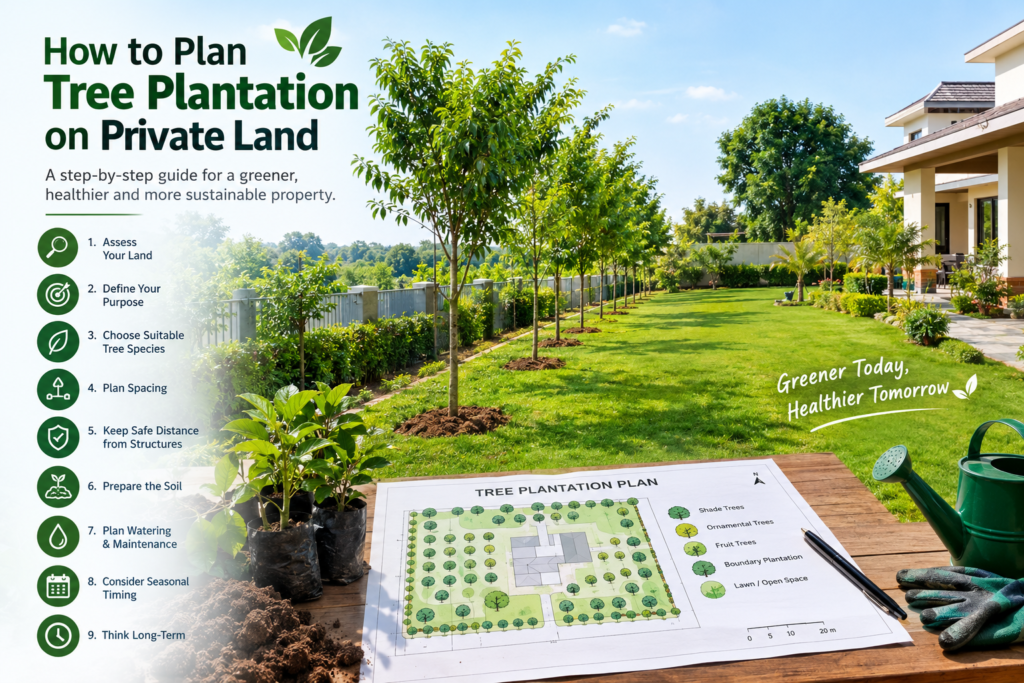
Tree plantation on private land is a long-term investment in shade, greenery, privacy, soil protection, and property value. Whether you own a residential plot, farmhouse, agricultural land, institutional property, or a large open space, successful plantation requires more than simply digging holes and planting trees.
A well-planned plantation considers the land size, soil condition, sunlight, water availability, tree spacing, climate, future growth, and maintenance requirements. Proper planning can help trees establish stronger roots and reduce future problems such as overcrowding, damaged structures, poor growth, and excessive maintenance.
1. Assess Your Land Before Planting
Start by understanding the characteristics of your private land. Measure the available plantation area and identify existing buildings, boundary walls, roads, pathways, electric lines, water pipes, and other structures.
Observe how sunlight moves across the property during the day. Some trees require full sunlight, while others can tolerate partial shade.
Also identify areas where rainwater naturally collects. Poorly drained locations may require drainage improvements before planting certain tree species.
A simple site assessment should include:
- Total plantation area
- Soil type and condition
- Sunlight exposure
- Water availability
- Drainage
- Existing vegetation
- Buildings and structures
- Boundary walls
- Underground and overhead utilities
- Access for maintenance
2. Define the Purpose of Tree Plantation
Before selecting trees, decide why you want to plant them. Different objectives require different plantation strategies.
For example, trees planted for shade should be positioned differently from trees planted for privacy or wind protection.
Common objectives include:
- Creating shade
- Improving privacy
- Developing a green boundary
- Reducing dust and wind
- Improving the appearance of a property
- Supporting biodiversity
- Creating an orchard
- Protecting soil from erosion
- Developing a long-term green landscape
Clearly defining the objective makes species selection and spacing much easier.
3. Choose Tree Species According to Site Conditions
One of the most important steps in private-land plantation is selecting trees that match local conditions.
Avoid choosing a tree simply because it looks attractive. Consider its mature height, canopy spread, root characteristics, water requirements, growth rate, and tolerance to local weather conditions.
For properties in and around Saharanpur, Uttar Pradesh, species selection should also consider the regional climate and soil conditions.
Depending on the purpose and site, suitable options may include trees such as Neem, Amaltas, Arjun, Jamun, Ashoka, Gulmohar, and other locally appropriate species.
The final selection should be based on the actual conditions of the site rather than a generic plant list.
4. Plan Tree Spacing Carefully
Planting trees too close together is a common mistake on private land.
Young trees may initially appear to have plenty of space, but their canopies and root systems expand as they mature. Overcrowding can reduce sunlight and airflow and increase competition for water and nutrients.
Spacing depends on the mature size of the tree. Large canopy trees generally need substantially more space than small ornamental trees.
Consider:
Tree height + canopy spread + root growth + nearby structures = required planting space
Always plan according to the mature tree rather than its size at the time of purchase.
5. Maintain Safe Distance From Buildings and Utilities
Tree placement should take future growth into account.
Large trees should not be planted immediately next to foundations, walls, underground pipelines, septic systems, or utility infrastructure without considering the potential impact of roots and mature canopy growth.
Similarly, trees with large branches should be positioned carefully around overhead electrical lines.
If the property contains important infrastructure, mark these areas on your plantation plan before purchasing plants.
6. Prepare the Soil Before Plantation
Healthy trees begin with healthy soil.
Before planting, inspect the soil for compaction, drainage problems, organic matter, and general fertility. Heavy or compacted soil may restrict root development.
Depending on the soil condition, preparation may include:
- Removing construction debris
- Improving soil structure
- Adding suitable organic matter
- Correcting drainage problems
- Breaking compacted soil
- Creating appropriate planting pits
Soil preparation should support root development rather than simply filling planting pits with excessive fertilizer.
7. Calculate the Number of Trees Required
Create a simple plantation layout before purchasing plants.
For example, divide the available plantation area into zones based on purpose:
Zone 1: Boundary plantation
Zone 2: Shade trees
Zone 3: Ornamental trees
Zone 4: Fruit trees
Zone 5: Open lawn or usable space
Then calculate the approximate number of trees required for each zone according to the planned spacing.
This approach helps prevent unnecessary purchases and makes the plantation more organized.
8. Plan Watering and Maintenance
Plantation planning does not end after planting.
Newly planted trees require consistent watering during their establishment period. The exact watering requirement depends on species, season, soil, rainfall, and site conditions.
Plan for:
- Initial irrigation
- Mulching
- Weed management
- Tree support where necessary
- Pest monitoring
- Pruning when appropriate
- Replacement of failed plants
A plantation that cannot be maintained properly may perform poorly even when the initial species selection was good.
9. Consider Seasonal Plantation Timing
Planting at a suitable time can make establishment easier.
In many parts of India, the monsoon season can provide favorable moisture conditions for plantation, although the best planting period varies according to species, local rainfall, soil drainage, and site conditions.
Avoid treating plantation timing as a fixed calendar rule. Local weather and soil moisture should be considered before planting.
10. Create a Long-Term Plantation Plan
Tree plantation is a long-term project. A tree that looks small when planted can eventually become a major landscape element.
Before finalizing your layout, visualize the property several years into the future.
Ask:
- How large will each tree become?
- Will branches interfere with buildings?
- Will mature trees block important views?
- Will roots affect nearby infrastructure?
- Will the trees receive enough sunlight?
- Can maintenance equipment access the area?
- Will the plantation still look balanced after 5–10 years?
Thinking ahead helps create a plantation that remains functional and attractive as the trees mature.
Tree Plantation Planning Checklist
| Planning Factor | What to Check |
|---|---|
| Land size | Measure the available plantation area |
| Soil | Check drainage, structure, and fertility |
| Sunlight | Identify full-sun and shaded areas |
| Purpose | Shade, privacy, fruit, boundary, landscape, etc. |
| Species | Match trees with site conditions |
| Spacing | Allow for mature canopy and root growth |
| Infrastructure | Check buildings, walls, pipes, and utilities |
| Water | Plan irrigation during establishment |
| Maintenance | Prepare for pruning, mulching, and monitoring |
| Future growth | Consider the mature size of every tree |
How Anuj Nursery Can Help With Tree Plantation
Planning a tree plantation project becomes easier when species selection, plant quality, quantity, and spacing are considered together. Anuj Nursery can help property owners explore suitable trees and plantation options for residential, agricultural, commercial, institutional, and large private properties in Saharanpur and nearby areas.
For larger plantation projects, prepare the site measurements and plantation objectives before discussing plant quantities. This helps create a more practical and cost-conscious plantation plan.
Conclusion
Planning tree plantation on private land requires a long-term approach. Start with a site assessment, define your objectives, select trees according to local conditions, calculate proper spacing, protect infrastructure, prepare the soil, and establish a realistic maintenance plan.
The most important principle is simple: plan for the mature tree, not the small plant you see on planting day.
A thoughtful plantation plan can turn unused private land into a functional, attractive, and sustainable green space for many years.