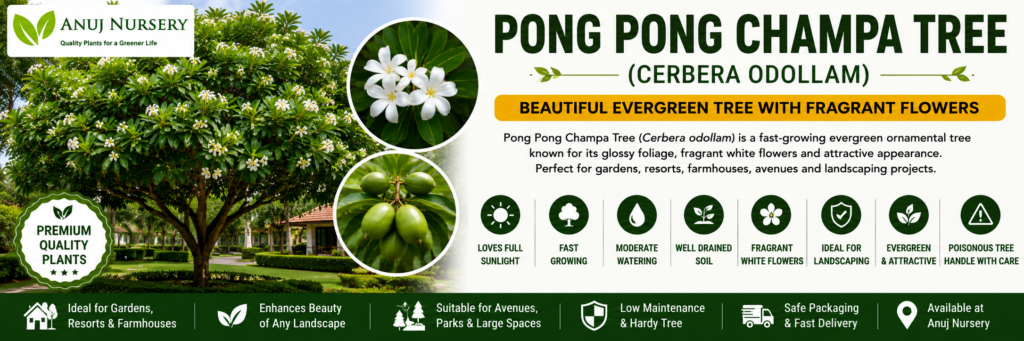
The Pong Pong Champa Tree, botanically known as Cerbera odollam, is an attractive evergreen ornamental tree recognized for its glossy green foliage, fragrant white flowers and distinctive appearance. It is commonly used in tropical and subtropical landscaping and is marketed by Indian nurseries under names such as Pong Pong Champa, Odollam Tree and other regional names.
Its elegant foliage and fragrant flowers can make it an eye-catching addition to gardens, resorts, farmhouses, parks and large landscape projects. However, there is one critical point buyers should understand: Cerbera odollam is highly poisonous. Its seeds and other plant parts should not be consumed, and the tree should be planted where children and pets cannot access fallen fruit or seeds.
What Is Pong Pong Champa?
Cerbera odollam belongs to the Apocynaceae family and is a tropical evergreen tree. It is commonly grown as an ornamental and landscaping tree because of its attractive foliage and flowers. Nursery listings describe it as an upright, medium-growing tree suitable for tropical and subtropical environments.
The tree produces glossy green leaves and white, fragrant flowers that have a distinctive appearance. Its fruits are green when developing and become more noticeable as they mature.
Because of its ornamental structure, Pong Pong Champa can be used to create a tropical and sophisticated look in large outdoor spaces.
Why Choose Pong Pong Champa Tree?
The Pong Pong Champa Tree can be considered for landscaping projects where an evergreen ornamental tree is required.
Key advantages include:
- Attractive evergreen foliage
- Fragrant white flowers
- Tropical ornamental appearance
- Suitable for large gardens
- Useful for resort and hotel landscaping
- Suitable for farmhouse landscapes
- Can be used in avenue-style planting
- Performs well in suitable warm climates
- Adds vertical structure to landscape designs
Nursery sources commonly list it for gardens, hotels, resorts, parks, farmhouses and other landscaping applications.
Pong Pong Champa Tree Care
1. Sunlight
Pong Pong Champa generally prefers good sunlight and warm growing conditions. Choose an open location where the tree receives sufficient natural light.
For newly planted nursery specimens, provide appropriate care during establishment, particularly if the plant was previously grown in partially protected nursery conditions.
2. Watering
Water the plant regularly while it is establishing. Once established in a suitable environment, watering requirements will depend on soil, rainfall and local temperatures.
The most important rule is to avoid permanently waterlogged soil. Good drainage helps maintain a healthier root environment.
3. Soil
Use well-drained soil for planting Cerbera odollam. The tree can adapt to suitable soil conditions, but areas where water remains stagnant should be avoided.
Before planting, check how quickly water drains from the site. Fixing poor drainage before planting is much easier than trying to correct root problems later.
4. Pruning
Regular pruning can be used to remove dead or unwanted branches and maintain a balanced landscape appearance. Avoid excessive pruning simply to force a particular shape.
For large landscaping projects, pruning should be planned according to the desired mature form and available space.
Pong Pong Champa for Indian Landscaping
The Pong Pong Champa Tree can be an attractive option for suitable warm and humid regions of India. It is particularly useful where a tropical evergreen appearance is desired.
For customers in Saharanpur, Uttar Pradesh and nearby areas, planting location should be selected carefully. Consider winter temperatures, available sunlight, soil drainage and the mature size of the tree before planting.
It can be used around farmhouses, resorts, hotels, parks and spacious residential gardens. However, because of its poisonous nature, avoid planting it beside children’s play areas, schools, pet areas or heavily used pedestrian paths.
Important Safety Warning
This is the part that should not be omitted from your commercial content.
Cerbera odollam is highly toxic. The plant is also known by the common name “suicide tree” because its seeds contain potent cardiac toxins. Therefore, the fruit and seeds should never be eaten, and the plant should be handled responsibly.
Do not market Pong Pong Champa as an edible fruit tree. Keep fallen fruits and seeds away from children and pets, and seek professional advice if accidental ingestion is suspected.
This safety information is particularly important for residential landscaping and public spaces.
How to Plant Pong Pong Champa
Select an open location with adequate sunlight and enough room for the tree to develop. Dig a planting hole wider than the root ball and place the plant at approximately the same depth at which it was growing in the nursery container.
Backfill with suitable soil and water thoroughly after planting. Maintain appropriate moisture during the establishment stage while ensuring that excess water can drain away.
Plan the final location carefully. Moving a mature tree later can be difficult and expensive.
Buy Pong Pong Champa Tree from Anuj Nursery
If you are searching for a Pong Pong Champa Tree, Cerbera odollam or ornamental landscaping tree in India, Anuj Nursery can be considered for landscaping and ornamental plant requirements.
Before purchasing, check:
- Overall plant health
- Foliage quality
- Stem strength
- Root condition
- Plant height
- Branching structure
- Correct botanical identification
- Suitability for your local climate
For buyers around Nagal, Saharanpur and Uttar Pradesh, choosing a healthy nursery-grown specimen and selecting the correct planting location can make establishment easier.
Frequently Asked Questions
What is the botanical name of Pong Pong Champa?
The botanical name is Cerbera odollam. It is also commonly called Pong Pong, Pong Pong Champa and Odollam Tree.
Is Pong Pong Champa poisonous?
Yes. Cerbera odollam is highly poisonous, particularly its seeds. It should never be treated as an edible fruit plant.
Is Pong Pong Champa good for landscaping?
Yes. Its evergreen foliage, fragrant flowers and tropical appearance make it suitable for gardens, resorts, farmhouses, parks and commercial landscaping.
Does Pong Pong Champa need sunlight?
It generally performs well in sunny, warm conditions. Providing adequate light is important for healthy ornamental growth.
Can Pong Pong Champa be planted near a house?
It can be used in residential landscapes, but its toxic nature means the location should be chosen carefully. Avoid areas where children or pets could access its fruits or seeds.
Final Thoughts
The Pong Pong Champa Tree (Cerbera odollam) is a visually striking evergreen ornamental tree that can give gardens and large landscaping projects a distinctive tropical appearance. Its glossy foliage and fragrant flowers make it attractive for resorts, farmhouses, parks and spacious residential landscapes.
For successful growth, focus on sunlight, good drainage, appropriate watering and sufficient planting space. Most importantly, treat the plant’s toxicity seriously.
For landscaping around Saharanpur, Nagal, Uttar Pradesh and other suitable Indian regions, choose a healthy nursery-grown Pong Pong Champa and place it responsibly. Beauty matters in landscaping—but safety matters more.