
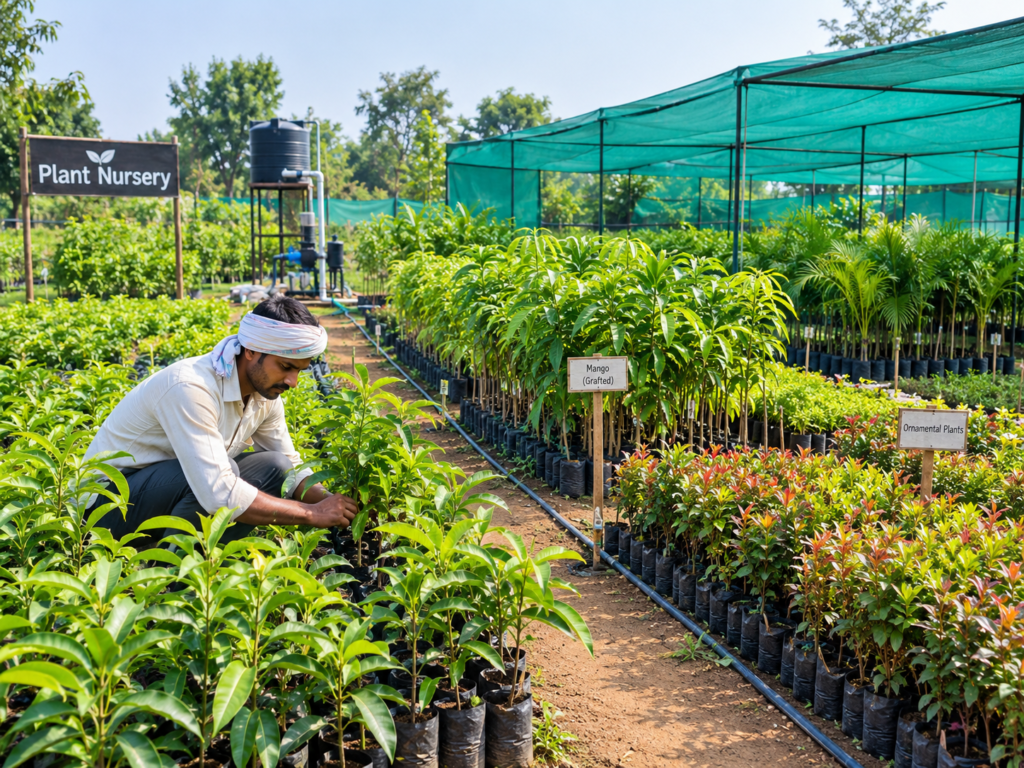
Starting a plant nursery can be a practical agricultural business for farmers who want to diversify their income and make productive use of available land. A well-planned nursery can supply fruit plants, ornamental plants, flowering plants, avenue trees, and landscaping plants to homeowners, landscapers, institutions, and other farmers.
However, successful nursery management requires more than simply growing plants. Proper site selection, irrigation, planting material, shade management, soil preparation, labour, and marketing all play an important role. This Nursery Setup Guide for Farmers explains the basic steps to start and manage a plant nursery successfully in India.
What Is a Plant Nursery?
A plant nursery is a place where young plants are propagated, grown, maintained, and prepared for transplantation or sale. Depending on the business model, farmers can produce plants from seeds, cuttings, grafting, budding, or other propagation methods.
A nursery may specialize in one category or offer multiple types of plants. Common options include:
- Fruit plants
- Timber trees
- Flowering plants
- Ornamental plants
- Indoor plants
- Avenue trees
- Landscaping plants
- Native and shade trees
Choosing the right plant categories should depend on local demand, climate, available land, water supply, and the farmer’s experience.
Step 1: Select a Suitable Nursery Site
The location is one of the first decisions when setting up a nursery. Select land with good drainage, reliable water availability, and convenient road access.
A nursery should ideally receive adequate sunlight while also having areas where young plants can be protected from excessive heat. Avoid low-lying locations where rainwater remains stagnant.
Easy road access is particularly useful because customers, landscapers, and plant buyers need convenient transportation for purchasing and moving plants.
Step 2: Plan the Nursery Layout
Before purchasing plants or infrastructure, prepare a simple nursery layout.
Divide the available space into different sections such as:
- Propagation area
- Shade-net area
- Mother plant section
- Growing area
- Hardening area
- Potting and soil-mixing area
- Water storage and irrigation section
- Plant display area
- Storage space
A planned layout makes daily operations easier and helps workers move plants without damaging them.
Step 3: Arrange Reliable Water and Irrigation
Water is essential for nursery production. Farmers should establish a dependable irrigation system before expanding plant production.
Depending on the nursery size, options may include drip irrigation, sprinklers, misting systems, or manual watering.
Drip irrigation can be useful for plants growing in containers because water can be delivered close to the root zone. In propagation areas, misting may be useful for maintaining appropriate moisture.
Always avoid excessive watering. Poor drainage combined with continuous moisture can damage roots and encourage plant-health problems.
Step 4: Prepare Quality Growing Media
Healthy nursery plants need suitable growing media. The exact mixture depends on the plant species and production method.
A growing medium should generally provide good drainage, adequate moisture retention, aeration, and support for root development. Farmers may use combinations of soil, compost, sand, cocopeat, or other suitable materials according to the plants being produced.
The material should be clean and free from unwanted weeds and visible contaminants.
Step 5: Choose Quality Planting Material
Quality planting material is one of the most important factors in nursery production.
For fruit plants, farmers may consider healthy grafted or budded plants of suitable varieties. For other plants, healthy seeds, cuttings, or mother plants should be selected.
Avoid starting commercial production with weak, diseased, or poorly developed planting material. Healthy starting material can make nursery management easier and improve customer satisfaction.
Step 6: Use Shade Nets and Protective Structures
Young plants can be sensitive to strong sunlight, wind, heavy rain, and temperature fluctuations. Shade-net structures can provide controlled conditions for sensitive plants.
However, every plant does not require the same amount of shade. Nursery managers should select shade levels according to plant requirements and growth stages.
A hardening area is also useful. Plants can gradually be exposed to outdoor conditions before they are sold or transplanted.
Step 7: Follow Regular Plant Care
Daily nursery management should include watering, weed removal, pruning, cleaning, plant inspection, and pest monitoring.
Farmers should regularly check plants for:
- Yellowing leaves
- Wilting
- Insect activity
- Leaf spots
- Root problems
- Broken branches
- Poor growth
Early identification of problems can help prevent them from spreading across nursery stock.
Step 8: Maintain Proper Plant Records
Record keeping is often overlooked by small nurseries, but it can make business management much easier.
Maintain basic information about plant varieties, propagation dates, quantities, purchase costs, selling prices, fertilizer applications, losses, and customer orders.
Plant labels should clearly identify varieties wherever necessary, particularly for fruit plants. Good records also help farmers understand which plants are in demand.
Step 9: Understand Your Local Market
Before producing thousands of plants, research local demand. Talk to farmers, landscapers, gardeners, schools, housing projects, institutions, and plant retailers.
For example, fruit plants may have strong demand in farming areas, while ornamental and landscaping plants may be more suitable near growing residential or commercial developments.
Producing according to demand can reduce unsold inventory and improve business efficiency.
Step 10: Market Your Nursery
A modern nursery can use both offline and online marketing.
Create a simple plant catalogue showing available varieties, plant sizes, photographs, and basic information. Local SEO, Google Business Profile, social media, WhatsApp enquiries, and a nursery website can help potential customers discover your business.
Farmers can also develop relationships with landscapers, builders, schools, hotels, resorts, and orchard owners for larger orders.
Why Quality Matters at Anuj Nursery
For farmers entering the nursery business, learning from an established nursery can provide useful practical knowledge about plant selection, maintenance, propagation, and customer requirements.
Anuj Nursery focuses on a wide range of plants suitable for gardens, landscaping, plantations, orchards, and other green projects. Farmers can use proper planning and quality planting material as the foundation for building their own nursery business.
Final Thoughts
Starting a plant nursery requires careful planning, but farmers can build a sustainable nursery operation by beginning with a manageable scale and expanding gradually.
The key areas are good location, reliable irrigation, quality planting material, suitable growing media, shade management, regular plant care, record keeping, and strong marketing.
Instead of producing every type of plant from the beginning, farmers can start with a focused selection that matches local demand. With consistent management and attention to plant quality, a well-organized nursery can become an important part of a diversified farming business.