
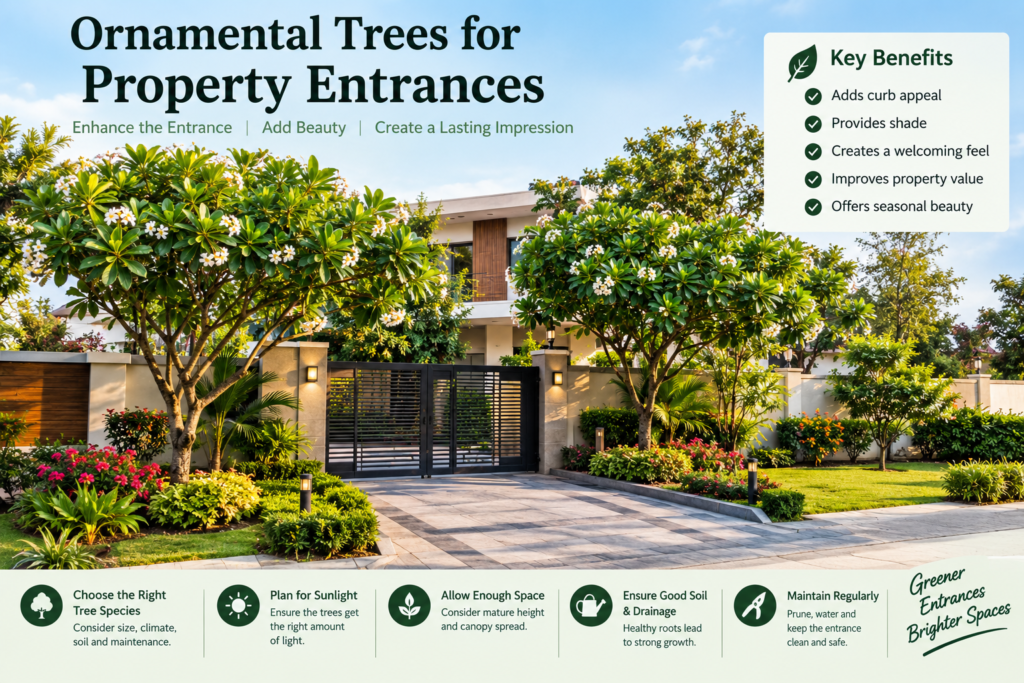
The entrance is one of the first parts of a property that visitors notice. Well-selected ornamental trees for property entrances can make the entrance more attractive, welcoming, and visually balanced. They can also provide shade, structure, seasonal color, and a stronger connection between the building and landscape.
However, choosing trees for an entrance is not simply about selecting the most beautiful species. The tree should match the available space, building design, climate, sunlight, soil, and maintenance requirements.
This guide explains how to select and plan ornamental trees for residential, commercial, institutional, and other property entrances.
Why Ornamental Trees Are Important for Property Entrances
Ornamental trees can become a major design feature around an entrance. A carefully positioned tree can frame an entry gate, soften hard surfaces, highlight a driveway, or create a natural transition between the road and building.
Depending on the species, ornamental trees can provide:
- Attractive flowers
- Decorative foliage
- Shade
- Privacy
- Visual screening
- Seasonal interest
- Architectural structure
- A more welcoming entrance
The objective should be to create an entrance where trees complement the property instead of blocking or overpowering it.
1. Consider the Size of the Entrance
Before selecting a tree, measure the available planting area.
A large property entrance may accommodate medium or large ornamental trees, while a narrow entrance may require smaller species.
Check the available space around:
- Gateways
- Driveways
- Parking areas
- Walkways
- Boundary walls
- Buildings
- Security cabins
- Signboards
- Utility lines
Always consider the tree’s mature size, not just the size of the plant when purchased.
A small nursery plant can eventually develop a wide canopy and extensive root system.
2. Choose Trees That Complement the Property
The tree should work with the architectural style of the property.
For modern buildings, trees with clean shapes and controlled growth may create a simple and elegant appearance. Traditional properties may work well with flowering or broad-canopy ornamental trees.
The goal is visual harmony.
Avoid choosing a tree simply because it looks attractive in isolation. Consider how its trunk, canopy, foliage, and flowers will look next to the building, entrance gate, driveway, and surrounding landscape.
3. Use Trees to Frame the Entrance
One effective landscaping technique is to use ornamental trees to frame an entrance.
For a wide entrance, trees can be positioned on either side of the driveway or gate to create balance. However, symmetrical planting is not always necessary.
A carefully positioned single specimen tree can also create a strong focal point.
When using two trees, consider their spacing and future canopy spread. Trees planted too close to the entrance can eventually obstruct movement or visibility.
4. Check Visibility and Safety
Entrance landscaping should look attractive without creating visibility problems.
Avoid placing dense trees or shrubs where they can block:
- Security cameras
- Gate visibility
- Vehicle movement
- Pedestrian pathways
- Property signs
- Street visibility
For commercial properties and busy driveways, maintaining clear sightlines is especially important.
Branches should also be managed so that they do not interfere with vehicles, lighting, signs, or overhead infrastructure.
5. Consider Sunlight and Soil Conditions
Before planting, examine the entrance site.
Some entrances may receive full sunlight throughout the day, while others may be shaded by buildings or boundary walls.
Also evaluate:
- Soil type
- Drainage
- Soil compaction
- Water availability
- Irrigation access
An ornamental tree that is suitable for full sun may not perform well in a heavily shaded entrance.
Good soil preparation and drainage can improve tree establishment and long-term growth.
6. Select Trees for the Local Climate
Climate is an important factor when selecting ornamental trees.
Consider local temperature, rainfall, humidity, seasonal changes, and exposure to wind.
For properties in Saharanpur and surrounding areas, choosing trees that are appropriate for local growing conditions can support healthier establishment and easier maintenance.
Local plant knowledge can be particularly useful when selecting trees for large landscaping projects.
7. Think About Flowers and Seasonal Interest
Flowering ornamental trees can create a strong visual impact at property entrances.
When selecting flowering trees, consider:
- Flower color
- Flowering season
- Flower duration
- Fragrance
- Leaf appearance
- Flower and leaf litter
A tree with attractive flowers can make an entrance stand out during its flowering season. Trees with attractive foliage or structure can continue providing visual interest after flowering ends.
8. Consider Tree Height and Canopy Shape
Tree shape matters as much as tree height.
Some trees develop upright forms, while others develop spreading or rounded canopies.
For entrance landscaping, consider whether the mature canopy will:
- Cover the building
- Interfere with signs
- Block lights
- Extend over driveways
- Obstruct pathways
- Create excessive shade
Choose a form that fits the available space.
9. Plan the Space Between Trees
Correct spacing is essential when planting multiple ornamental trees.
Trees planted too close together may compete for sunlight, water, nutrients, and root space. Their canopies may also become crowded as they mature.
The correct spacing depends on the selected species and its mature dimensions.
Do not use a fixed distance for every tree. Instead, check the expected mature canopy spread and plan accordingly.
10. Combine Trees With Other Landscape Plants
Ornamental trees can look more natural when combined with shrubs, flowering plants, groundcovers, lawn, and hardscape elements.
For example, an entrance landscape can include:
Upper layer: Ornamental trees
Middle layer: Shrubs and flowering plants
Lower layer: Groundcovers or seasonal flowers
Surface: Lawn, paving, or decorative mulch
This layered approach can add depth without making the entrance look overcrowded.
11. Consider Maintenance Requirements
Entrance trees are highly visible, so maintenance is important.
Regular maintenance may include:
- Pruning
- Watering
- Mulching
- Pest monitoring
- Removing damaged branches
- Cleaning fallen leaves and flowers
- Maintaining surrounding plants
Choose trees according to the property’s maintenance capacity.
A commercial entrance may require a cleaner and more controlled appearance than a private garden, especially where customers or visitors frequently arrive.
12. Avoid Common Entrance Landscaping Mistakes
Several mistakes can reduce the long-term value of ornamental trees.
Planting Too Close to the Gate
The tree may eventually obstruct the gate or driveway.
Ignoring Mature Size
A tree that looks suitable today may become too large in a few years.
Blocking Visibility
Dense foliage can interfere with security and vehicle visibility.
Ignoring Root Space
Trees need sufficient underground space for healthy development.
Choosing Only for Flower Color
Flower color is important, but climate, soil, size, and maintenance are equally important.
Overcrowding the Entrance
Too many trees and plants can make the entrance look smaller and difficult to maintain.
How to Plan Ornamental Trees for a Property Entrance
A simple planning process can make selection easier:
- Measure the entrance area.
- Identify existing structures and utilities.
- Check sunlight and soil conditions.
- Decide the desired landscape purpose.
- Determine suitable mature tree size.
- Select appropriate ornamental species.
- Plan tree spacing.
- Add shrubs and groundcovers if required.
- Plan irrigation.
- Create a long-term maintenance schedule.
This approach helps ensure that the trees remain attractive as they mature.
Ornamental Trees for Property Entrances in Saharanpur
Property owners in Saharanpur can choose ornamental trees according to local climate, available space, soil conditions, and landscape requirements. The right selection can work for residential entrances, farmhouses, offices, hotels, institutions, commercial properties, and larger landscaping projects.
Anuj Nursery can be considered for ornamental plants and landscaping requirements in the Saharanpur and Nagal area. When selecting trees, discuss the property’s available space, sunlight, intended purpose, and expected mature size before purchasing.
Final Thoughts
The best ornamental trees for property entrances are not necessarily the largest or most colorful trees. They are trees that fit the property, perform well in the local environment, and remain manageable as they mature.
Focus on mature size, canopy shape, sunlight, soil, drainage, spacing, visibility, maintenance, and overall landscape design. With careful planning, ornamental trees can create an entrance that looks attractive today and continues to work well for many years.