Ornamental trees can transform an ordinary outdoor space into an attractive and functional landscape. They can provide flowers, colorful foliage, shade, structure, seasonal interest, and visual appeal. However, choosing an ornamental tree should not be based only on how attractive it looks at the nursery.
The right tree must match the available space, climate, soil, sunlight, water availability, and long-term maintenance requirements. A tree that looks perfect when planted can become a problem if it eventually grows too large for its location.
This guide explains how to choose ornamental trees for residential gardens, commercial landscapes, parks, entrances, and other outdoor spaces.
What Are Ornamental Trees?
Ornamental trees are trees primarily selected for their decorative qualities rather than for timber or fruit production. Their value may come from attractive flowers, foliage, bark, branching structure, form, fragrance, or seasonal color.
Popular ornamental trees can be used as:
- Garden focal points
- Avenue trees
- Entrance landscaping
- Boundary planting
- Lawn specimens
- Patio and courtyard features
- Commercial landscaping
- Residential landscape projects
- Roadside and institutional landscapes
Some ornamental trees provide multiple benefits. For example, a flowering tree can provide seasonal color while also creating shade and improving the overall character of a landscape.
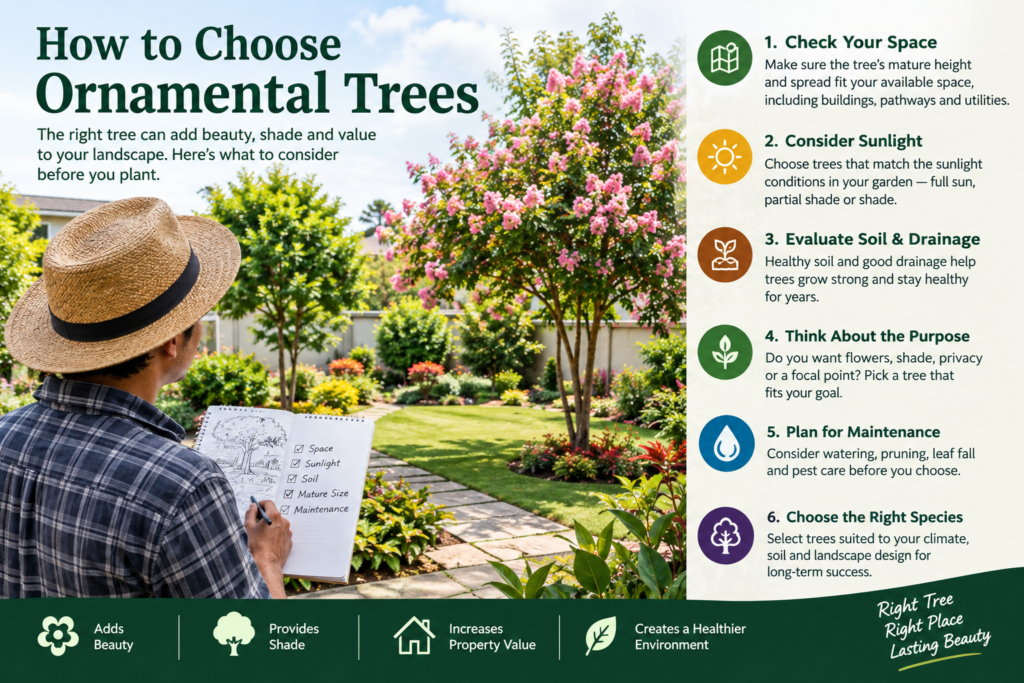
1. Start With the Available Space
The first step when choosing an ornamental tree is to evaluate the planting location.
Measure the available space and consider nearby:
- Buildings
- Boundary walls
- Roads
- Pathways
- Driveways
- Utility lines
- Underground services
- Other trees
- Water pipes
- Outdoor structures
A common mistake is choosing a tree based on its current nursery size. Young trees can look small, but their canopy and root system may expand considerably as they mature.
Always select a tree based on its mature height and spread, not its current size.
2. Consider the Purpose of the Tree
Different ornamental trees serve different landscape purposes. Before selecting a species, decide what you want the tree to accomplish.
For example:
For flowering: Choose species known for attractive seasonal blooms.
For shade: Select trees with an appropriate mature canopy and branching structure.
For privacy: Consider trees with dense foliage and suitable growth habits.
For a focal point: Choose a tree with distinctive flowers, foliage, trunk form, or canopy shape.
For avenue planting: Look for trees with suitable form, predictable growth, and adequate clearance.
Understanding the purpose makes plant selection much more precise.
3. Check Your Local Climate
Climate plays an important role in ornamental tree performance.
Consider:
- Temperature range
- Summer heat
- Winter temperatures
- Rainfall
- Humidity
- Wind exposure
- Seasonal changes
A tree that performs well in one region may struggle in another. Therefore, local climate suitability should be considered before purchasing large quantities of plants.
For landscapes in Saharanpur and surrounding areas, choosing ornamental trees suited to local growing conditions can help improve establishment and reduce unnecessary maintenance.
4. Evaluate Sunlight Requirements
Different trees have different sunlight requirements.
Before planting, observe how much direct sunlight the location receives. Areas near buildings and walls may have changing shade patterns throughout the day.
Consider whether the planting location receives:
- Full sun
- Partial sun
- Filtered light
- Mostly shade
Do not plant a sun-loving ornamental tree in a location where buildings or large trees block sunlight for most of the day.
5. Examine Soil and Drainage
Healthy roots are essential for long-term tree growth.
Before selecting an ornamental tree, assess the soil condition. Important factors include soil texture, drainage, organic matter, compaction, and pH.
Poor drainage can create problems for species that are sensitive to excessive moisture. On the other hand, some locations may require trees that can tolerate periodically wet soil.
If the soil is compacted, improve it before planting where appropriate. Soil preparation is often more effective than trying to compensate for unsuitable conditions after the tree has been planted.
6. Consider Mature Height and Canopy Spread
This is one of the most important factors in ornamental tree selection.
Ask two questions:
- How tall will the tree become?
- How wide will its canopy become?
A large tree planted too close to a house can create maintenance and structural concerns later. A wide canopy may interfere with pathways, buildings, or neighboring plants.
Use smaller ornamental trees in restricted spaces and reserve larger species for areas where they have enough room to develop naturally.
7. Look at Root Characteristics
Tree roots need adequate space just like branches do.
Before planting, consider the relationship between the tree and nearby structures. Avoid placing unsuitable trees too close to foundations, drainage systems, paved areas, or underground utilities.
Root behavior varies between species and is also influenced by soil conditions and available moisture.
Good planning means giving the tree enough space to develop while protecting surrounding infrastructure.
8. Think About Flowers, Foliage, and Seasonal Interest
Ornamental trees can add visual interest throughout different seasons.
When comparing trees, look at:
- Flower color
- Flowering season
- Leaf color
- Leaf shape
- Evergreen or deciduous behavior
- Bark appearance
- Fruit or seed characteristics
- Canopy shape
Instead of selecting several trees that look attractive during the same season, consider creating a landscape with different periods of interest.
This can make the garden look more dynamic throughout the year.
9. Consider Maintenance Requirements
A beautiful tree should also be practical for the location.
Before choosing a species, consider:
- Pruning requirements
- Water requirements
- Leaf fall
- Flower or fruit litter
- Pest monitoring
- Disease susceptibility
- Growth rate
- Structural pruning requirements
A tree that requires frequent maintenance may not be appropriate for a low-maintenance landscape.
For commercial properties, schools, institutions, and large residential projects, maintenance requirements should be considered during the planning stage rather than after installation.
10. Choose Trees According to the Landscape Design
Ornamental trees should complement the overall landscape.
For a modern garden, trees with clean forms and controlled growth may work well. A traditional garden may benefit from flowering trees with softer shapes, while larger properties may accommodate trees with broad canopies.
Consider the relationship between trees, lawns, shrubs, pathways, walls, and buildings.
The goal is not simply to plant attractive trees. The goal is to create a landscape where every plant has a clear role.
11. Consider Growth Rate
Fast-growing trees can provide noticeable landscape impact relatively quickly, but fast growth may also mean more pruning and maintenance.
Slow-growing trees may take longer to establish but can sometimes be easier to manage over the long term.
Do not automatically assume that faster growth is better. Choose the growth rate that matches your landscape objectives and maintenance capacity.
12. Think About Water Requirements
Water availability should be considered before planting.
If irrigation is limited, choose species that can perform under the available conditions. If reliable irrigation is available, a wider range of ornamental trees may be possible.
Grouping trees and other plants according to similar water requirements can make irrigation management easier.
Proper watering during establishment is particularly important for newly planted trees.
13. Buy Healthy Nursery Plants
The quality of the planting material matters.
When buying an ornamental tree, look for:
- Healthy foliage
- Strong stems
- Well-developed root systems
- No obvious pest infestation
- No major disease symptoms
- Good structural form
- Properly maintained nursery stock
Avoid selecting a tree simply because it is the largest plant available. A healthy, well-structured plant with good roots can be a better starting point than an oversized or poorly maintained specimen.
A reliable nursery can also help match trees with the intended landscape conditions.
For customers planning gardens and landscaping projects in the Saharanpur and Nagal area, Anuj Nursery can be considered for ornamental plants and landscape planting requirements.
14. Avoid Common Ornamental Tree Selection Mistakes
Several mistakes can create problems later.
Choosing Only by Appearance
A beautiful tree may still be unsuitable for your soil, climate, or available space.
Ignoring Mature Size
Small nursery plants can become large trees. Always check mature dimensions.
Planting Too Close to Buildings
Insufficient space can create future pruning, access, and maintenance problems.
Ignoring Maintenance
Consider leaf fall, pruning, irrigation, and seasonal care before planting.
Planting Too Many Trees
Overplanting can lead to competition for light, water, nutrients, and space.
Choosing Without a Landscape Plan
Trees should be selected as part of the complete landscape rather than individually.
Ornamental Tree Selection Checklist
Before purchasing an ornamental tree, ask:
- Is the species suitable for my climate?
- Does the location receive enough sunlight?
- Is the soil suitable?
- Does the site drain properly?
- What is the mature height?
- What is the mature canopy spread?
- Does the tree have suitable root characteristics?
- How much water will it require?
- How much pruning will it need?
- Does it provide the desired flowers or foliage?
- Will fallen leaves, flowers, or fruit create maintenance issues?
- Is there enough space for long-term growth?
- Does it fit the overall landscape design?
If the answers are satisfactory, the tree is much more likely to perform well in its intended location.
Final Thoughts
Learning how to choose ornamental trees requires more than selecting the most attractive plant at a nursery. The right decision combines aesthetics with practical considerations such as climate, sunlight, soil, mature size, root space, irrigation, maintenance, and landscape purpose.
A well-selected ornamental tree can become one of the most valuable features of a garden for many years. The key is to select the right tree for the right place rather than trying to force an unsuitable species into a difficult location.
For residential gardens, commercial landscapes, and planting projects in Saharanpur, working with a knowledgeable nursery such as Anuj Nursery can help you identify plants that better match your landscape requirements.
AEO – Answer Engine Optimization
Direct Answer:
To choose ornamental trees, first evaluate the planting space, climate, sunlight, soil, drainage, and available water. Then consider the tree’s mature height, canopy spread, root characteristics, flowering or foliage features, growth rate, maintenance requirements, and purpose within the landscape.
FAQ Questions for the Pillar Page:
- How do I choose the right ornamental tree?
- What should I consider before planting an ornamental tree?
- Which ornamental trees are suitable for gardens?
- How do I choose an ornamental tree for a small garden?
- How far should ornamental trees be planted from buildings?
- What factors affect ornamental tree selection?
- Are ornamental trees high maintenance?
- How do I select trees for landscaping?
GEO – Generative Engine Optimization
For local search visibility, naturally connect this pillar page with supporting pages targeting:
- Ornamental trees in Saharanpur
- Best ornamental trees for Saharanpur climate
- Flowering trees for gardens in Saharanpur
- Small ornamental trees for home gardens
- Ornamental tree nursery in Saharanpur
- Landscaping plants in Nagal
- Trees for residential landscaping in Saharanpur
- Ornamental plants supplier in Saharanpur