
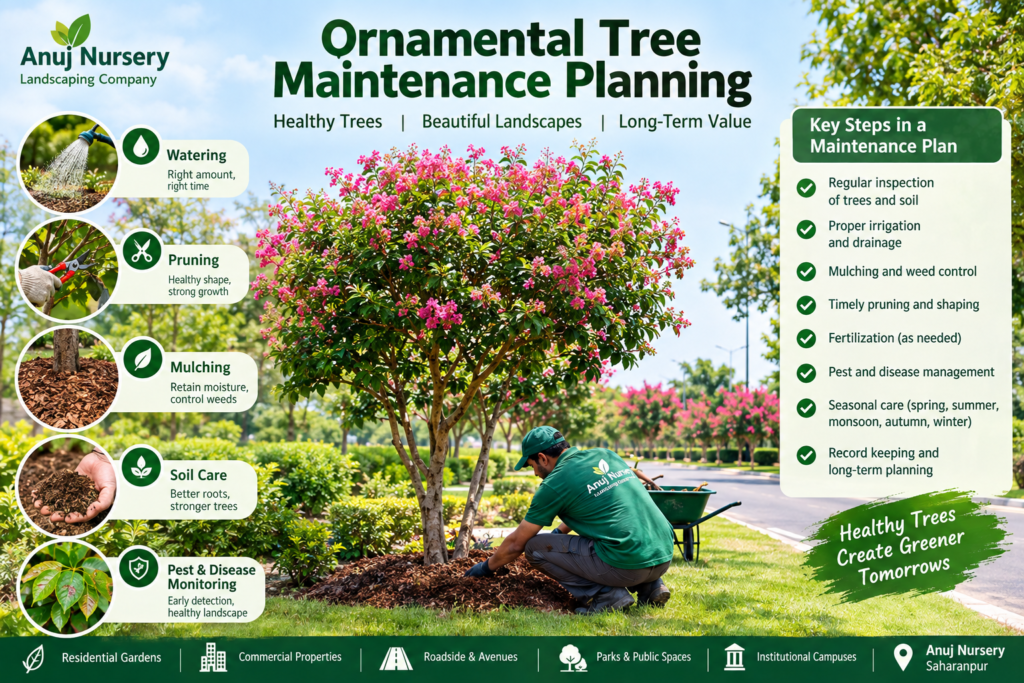
Beautiful ornamental trees do not stay healthy and attractive without regular care. A well-designed maintenance plan helps trees develop strong structures, maintain their natural shape, produce healthy foliage, and remain suitable for residential, commercial, roadside, and public landscapes.
Ornamental Tree Maintenance Planning involves much more than occasional watering. A complete plan should include irrigation, pruning, mulching, soil management, pest and disease monitoring, seasonal inspections, and long-term landscape assessment.
Proper planning is especially important for large landscapes where dozens or hundreds of trees may require coordinated care. A tree inventory can also help landscape managers identify trees that need irrigation, pruning, inspection, or replacement.
For homeowners and landscape professionals in India, including Saharanpur and nearby areas, a practical maintenance schedule can make ornamental landscapes easier to manage throughout the year.
Why Is Ornamental Tree Maintenance Important?
Ornamental trees contribute shade, color, structure, privacy, and visual appeal to landscapes. However, poor maintenance can lead to weak branches, excessive growth, dry soil, pest problems, poor flowering, and an untidy appearance.
Regular maintenance helps you:
- Encourage healthy tree growth
- Maintain attractive canopy shape
- Reduce dead and damaged branches
- Improve soil moisture management
- Control weeds around the root zone
- Detect pests and diseases early
- Protect trees from mechanical damage
- Reduce expensive corrective work later
- Maintain the overall appearance of the landscape
The best approach is preventive maintenance rather than waiting until a tree develops a serious problem.
What Should an Ornamental Tree Maintenance Plan Include?
A complete maintenance plan should cover the entire life cycle of the tree.
1. Tree Inspection
Begin with regular visual inspections. Check the trunk, branches, leaves, soil, root zone, and surrounding landscape.
Look for:
- Dead or broken branches
- Discolored or damaged leaves
- Unusual growth
- Pest activity
- Fungal symptoms
- Soil compaction
- Poor drainage
- Exposed roots
- Mechanical damage
- Dry or excessively wet soil
For large commercial or institutional landscapes, maintaining a tree inventory can make inspection and maintenance scheduling easier.
2. Watering Management
Water is especially important during the establishment period after planting. Newly planted trees generally require more frequent watering until their root systems become established.
However, watering should not simply mean giving a small amount of water every day indefinitely.
A good irrigation plan should consider:
- Tree age
- Species
- Soil type
- Drainage
- Weather conditions
- Season
- Root-zone size
- Local rainfall
Deep, appropriate watering is generally more useful than frequent shallow watering for established trees because it encourages moisture deeper into the root zone.
Avoid both extremes. Underwatering can cause stress, while excessive watering can reduce oxygen availability around roots and contribute to root problems, particularly in poorly drained or compacted soils.
3. Mulching
Mulching is one of the simplest ways to support ornamental tree maintenance.
Organic mulch can help conserve soil moisture, moderate soil temperature, suppress weeds, and reduce soil compaction around the root zone.
Apply mulch in a broad layer around the tree rather than creating a thick mound against the trunk.
Keep the trunk and root flare visible. Excessive mulch against the trunk can increase moisture-related problems and encourage decay.
For many landscape situations, a mulch layer around 2–3 inches deep is recommended by extension guidance, with the exact application adapted to local conditions.
4. Pruning and Canopy Management
Pruning is an important part of ornamental tree maintenance because it helps preserve structure, appearance, clearance, and long-term health.
Focus on removing:
- Dead branches
- Broken branches
- Diseased branches
- Crossing or rubbing branches
- Poorly positioned growth
- Certain competing leaders when appropriate
Young trees benefit from thoughtful structural training because early correction can reduce the need for expensive pruning later.
Avoid indiscriminate topping. Excessive removal of large branches can damage natural tree form and encourage weak regrowth.
Pruning should always be adapted to the species, growth habit, age, season, and landscape objective.
5. Soil and Root-Zone Management
Healthy roots are the foundation of a healthy ornamental tree.
Regularly inspect the soil around trees for:
- Compaction
- Poor drainage
- Excessive dryness
- Standing water
- Weed competition
- Exposed roots
- Reduced organic matter
Tree roots require both moisture and oxygen. Therefore, constantly saturated soil can be as problematic as extremely dry soil.
Avoid unnecessary disturbance of the root zone, particularly from heavy equipment, construction, or repeated foot traffic.
6. Fertilization Planning
Fertilizer should not automatically be applied simply because a tree is growing slowly.
The need for nutrients depends on the species, soil conditions, symptoms, growth performance, and landscape environment. Soil testing can help determine whether additional nutrients are actually required.
For newly planted trees, the priority should generally be successful establishment rather than excessive stimulation of top growth. Penn State Extension also recommends using fertilizer judiciously and considering soil fertility before application.
A professional landscape maintenance plan should therefore include fertilizer assessment rather than routine over-application.
7. Pest and Disease Monitoring
Regular inspection makes it easier to identify problems before they become severe.
Watch for:
- Leaf spots
- Powdery growth
- Wilting
- Unusual discoloration
- Chewed leaves
- Scale insects
- Aphids
- Borers
- Sudden branch dieback
Do not automatically treat every symptom with pesticides. First identify the likely cause and determine whether treatment is necessary.
Good site selection, adequate spacing, appropriate watering, healthy soil, and proper pruning can reduce plant stress and support better resistance to many landscape problems.
Seasonal Ornamental Tree Maintenance Planning
A seasonal schedule makes tree care easier to organize.
Spring
Spring is a useful time for:
- Checking winter damage
- Inspecting new growth
- Refreshing mulch
- Monitoring pests
- Reviewing irrigation systems
- Planning appropriate pruning
Flowering trees should be pruned according to their flowering cycle and species requirements.
Summer
Summer maintenance should focus strongly on:
- Irrigation
- Soil moisture
- Mulch condition
- Heat stress
- Pest monitoring
- Broken or storm-damaged branches
Young trees may require particular attention during periods of high heat and limited rainfall.
Monsoon
For landscapes in India, the monsoon season requires attention to drainage.
Check for:
- Waterlogging
- Soil erosion
- Root exposure
- Damaged branches
- Fungal problems
- Excessive weed growth
Good drainage is especially important where heavy rainfall can leave soil saturated.
Autumn and Winter
Depending on the species and local climate, this period can be used for:
- Structural inspection
- Planned pruning
- Soil assessment
- Mulch management
- Irrigation adjustment
- Annual maintenance review
The exact schedule should always be adapted to the local climate and individual tree species.
Ornamental Tree Maintenance for Indian Landscapes
India’s diverse climates mean that ornamental tree maintenance cannot follow one universal schedule.
Trees planted in Saharanpur, Nagal, Delhi-NCR, or other North Indian locations may experience hot summers, monsoon rainfall, and cooler winters. Irrigation, pruning, soil management, and pest monitoring should therefore be adjusted according to seasonal conditions.
The selection of trees is equally important. Matching a tree to available sunlight, soil, drainage, planting space, and climate can reduce future maintenance problems.
Anuj Nursery can be considered when selecting ornamental and landscaping plants for residential gardens, commercial properties, institutional campuses, avenues, and larger landscape projects.
How to Create a Professional Maintenance Schedule
For larger landscapes, divide maintenance into three categories:
Weekly:
Inspect irrigation, check newly planted trees, look for visible pest or disease symptoms, and remove obvious damaged material.
Monthly:
Review soil moisture, mulch condition, canopy development, weeds, irrigation performance, and general tree health.
Seasonally:
Carry out detailed inspections, planned pruning, irrigation adjustments, soil assessments, pest monitoring, and landscape performance reviews.
Annually:
Update the tree inventory, evaluate mature growth, review maintenance costs, identify replacement requirements, and revise the following year’s maintenance plan.
This structured approach makes maintenance more predictable and helps landscape managers prioritize resources.
Common Ornamental Tree Maintenance Mistakes
Avoid these common mistakes:
Overwatering
More water does not always mean healthier trees. Poorly drained soil can remain saturated and reduce oxygen around roots.
Over-Mulching
Never create a thick “mulch volcano” around the trunk. Keep the trunk and root flare visible.
Excessive Pruning
Removing too much foliage can stress young trees and destroy their natural form.
Ignoring Young Trees
Newly planted trees require particular attention while their root systems establish.
Planting Without Long-Term Planning
A tree that looks perfect when planted may become too large for the available space later.
Delaying Inspections
Small problems are generally easier to address than major structural, irrigation, or health issues.
Frequently Asked Questions
What is ornamental tree maintenance planning?
Ornamental tree maintenance planning is a structured system for managing watering, pruning, mulching, soil care, inspections, pest monitoring, and seasonal maintenance to keep ornamental trees healthy and attractive.
How often should ornamental trees be watered?
Watering frequency depends on tree age, species, soil, rainfall, temperature, and drainage. Newly planted trees usually need more frequent watering during establishment than established trees.
When should ornamental trees be pruned?
The appropriate pruning time depends on the tree species and purpose of pruning. Structural pruning of young trees should be carefully planned, while dead or damaged branches may require prompt removal.
How often should mulch be applied?
Mulch should be inspected regularly and replenished as it decomposes, but excessive depth should be avoided. Keep mulch away from direct contact with the trunk.
How can I reduce ornamental tree maintenance costs?
Choose trees suited to the site, provide adequate planting space, establish an irrigation plan, inspect trees regularly, and perform appropriate structural maintenance while trees are young.
Conclusion
A successful Ornamental Tree Maintenance Planning strategy combines regular inspection, appropriate watering, correct mulching, thoughtful pruning, soil management, and seasonal monitoring.
The most effective maintenance begins before problems appear. Selecting the right tree for the right location, providing adequate root space, and establishing a consistent care schedule can improve long-term landscape performance.
For residential gardens, commercial properties, roadside avenues, parks, institutional campuses, and large landscaping projects, a planned maintenance program can help ornamental trees remain healthy, attractive, and functional for many years.
With the right plant selection and professional planning, Anuj Nursery can support your ornamental tree and landscaping plant requirements in Saharanpur and surrounding areas.