
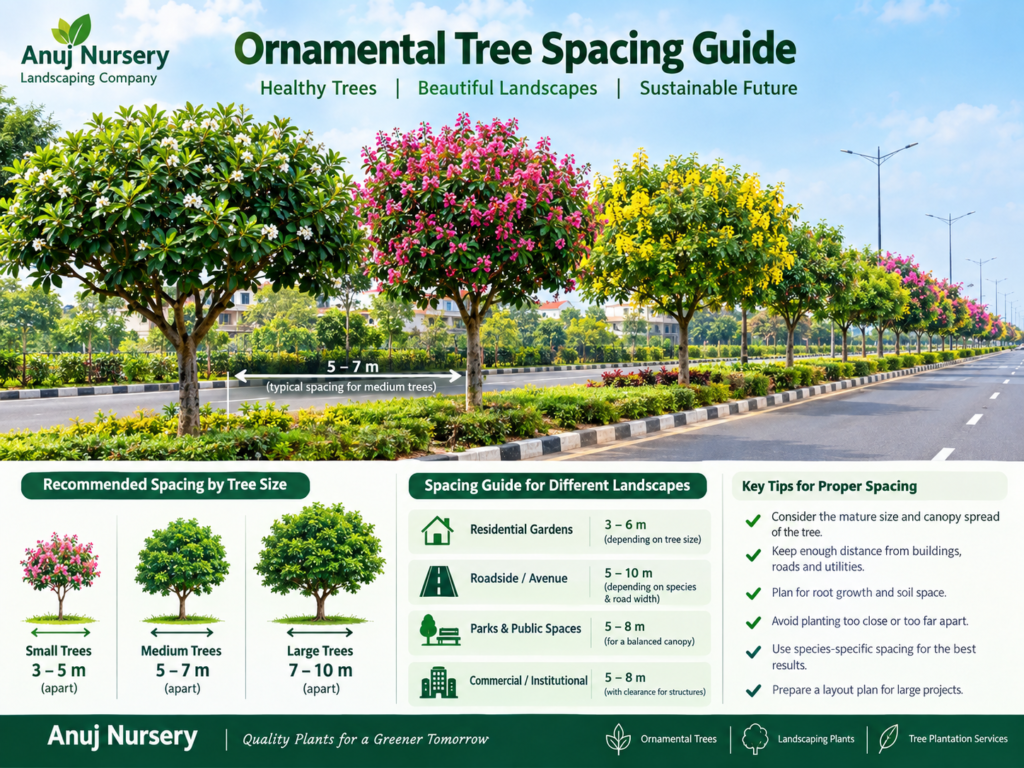
Proper tree spacing is one of the most important parts of successful landscape planning. Ornamental trees need enough room to develop their roots, branches, canopy, and overall form without competing excessively with nearby plants, buildings, roads, or utility infrastructure.
This Ornamental Tree Spacing Guide explains how to determine suitable planting distances for residential gardens, roadsides, parks, commercial properties, institutional landscapes, and large plantation projects.
Correct spacing improves the appearance of a landscape while also making irrigation, pruning, maintenance, and future growth easier to manage. Whether you are planting flowering trees, avenue trees, shade trees, or decorative specimens, planning the distance before planting can prevent costly problems later.
At Anuj Nursery, ornamental and landscape plants can be selected according to the site, landscape purpose, available space, and expected mature growth.
Why Is Ornamental Tree Spacing Important?
Trees may look small when purchased from a nursery, but many ornamental species become significantly wider and taller as they mature. Planting them too close together can create several problems.
Crowded trees may develop uneven canopies, compete for sunlight, and restrict airflow. Their roots can also compete for water and nutrients. In roadside or commercial landscapes, poorly spaced trees may interfere with walkways, lighting, signs, buildings, or vehicle movement.
On the other hand, excessive spacing can make a landscape appear empty and reduce the visual impact of an avenue or garden.
The goal is to create enough space for healthy growth while achieving the desired landscape effect.
General Ornamental Tree Spacing Guidelines
There is no single spacing distance that works for every ornamental tree. Mature canopy size, tree height, growth rate, root characteristics, landscape purpose, and site conditions should all be considered.
As a general planning approach:
- Small ornamental trees: approximately 3–5 metres apart
- Medium ornamental trees: approximately 5–7 metres apart
- Large ornamental trees: approximately 7–10 metres or more apart
- Roadside avenue trees: commonly 5–10 metres apart depending on species and road design
- Large park landscapes: spacing should be based on mature canopy spread and the intended visual composition
These are planning ranges rather than fixed rules. Always check the mature dimensions and growth characteristics of the selected species before finalizing a planting layout.
How to Calculate Tree Spacing
A simple way to estimate spacing is to consider the mature canopy spread of the tree.
For example, if an ornamental tree is expected to develop a canopy approximately 6 metres wide, planting several trees at only 2–3 metre intervals may eventually create excessive crowding.
For a natural-looking landscape, trees can often be positioned so their mature canopies have some separation. For a formal avenue, closer spacing may be appropriate when a continuous canopy effect is desired.
The landscape objective matters just as much as the tree’s mature size.
Ornamental Tree Spacing for Residential Gardens
Residential gardens require careful planning because trees are often planted near houses, boundary walls, driveways, patios, and utility areas.
Small ornamental trees can work well in compact gardens, while larger species require greater setbacks and open space.
When planning trees around a home, consider:
- Distance from the building
- Mature canopy width
- Root development
- Branch spread
- Sunlight requirements
- Driveway and pathway clearance
- Underground utilities
- Future maintenance requirements
Avoid selecting a large-growing tree simply because it looks attractive in a young nursery plant. Think about its mature size and the available space several years after planting.
Ornamental Tree Spacing for Roadsides and Avenues
Roadside landscapes require a different approach. Trees must provide visual appeal without creating safety or maintenance problems.
For avenue planting, maintain adequate distance between trees and consider the width of the road, pedestrian movement, drainage, streetlights, signs, and overhead utilities.
Flowering ornamental trees can create attractive seasonal displays when planted along roads, entrances, institutional campuses, and commercial properties.
However, the spacing should allow sufficient visibility and maintenance access. Trees should not block road signs, intersections, lighting systems, or pedestrian pathways.
Tree Spacing for Parks and Public Landscapes
Parks provide more flexibility because there is generally more open space. Trees can be planted individually as focal points, in groups, or in formal rows.
For natural-style landscapes, irregular spacing can create a softer appearance. Formal gardens may use consistent spacing to create symmetry.
Large trees should generally receive more space than compact ornamental varieties. Group planting can also be used to create shade zones, visual screens, or attractive background planting.
Spacing Between Trees and Buildings
One of the most common landscaping mistakes is planting a tree too close to a building.
Before planting, consider the mature canopy and potential root development. Larger ornamental trees generally require more distance from structures than small decorative trees.
Maintaining appropriate clearance can reduce future conflicts involving branches, walls, windows, drainage systems, and maintenance access.
The exact setback should be determined according to the species, mature dimensions, local site conditions, and applicable landscape or infrastructure requirements.
Ornamental Tree Spacing and Root Growth
Tree spacing is not only about the visible canopy. Roots also require adequate soil volume and access to water, oxygen, and nutrients.
Compacted soil, paved surfaces, and restricted planting pits can limit root development even when trees appear adequately spaced above ground.
For urban landscapes, provide the largest practical soil area and avoid creating unnecessarily small planting pits. Good soil preparation and drainage can help newly planted ornamental trees establish more successfully.
Common Tree Spacing Mistakes
Several spacing mistakes can reduce the long-term quality of a landscape:
1. Planting Based on Current Size
A small nursery tree can eventually become a large landscape specimen. Always plan according to mature size.
2. Ignoring Canopy Width
Tree height alone does not determine spacing. A wide canopy may require significantly more room.
3. Planting Too Close to Structures
Trees planted close to buildings, walls, or pathways can create maintenance problems as they mature.
4. Ignoring Utilities
Overhead wires, underground services, streetlights, and drainage systems should be considered before planting.
5. Using the Same Spacing for Every Species
Different ornamental trees have different growth habits. Spacing should be customized according to the selected species.
How to Plan an Ornamental Tree Layout
A successful planting plan starts with a basic site assessment.
First, measure the available area and identify buildings, roads, pathways, utility lines, drainage zones, and existing trees. Next, select species according to climate, soil, sunlight, water availability, and landscape purpose.
Then determine the mature height and canopy spread of each tree. Use this information to establish planting distances.
For larger projects, prepare a planting layout or landscape plan before purchasing the complete quantity of plants.
This approach can reduce unnecessary replacement, overcrowding, and future maintenance costs.
Ornamental Tree Spacing for Indian Landscapes
India has a wide range of climates, from hot and dry regions to humid, tropical, subtropical, and cooler areas. Therefore, ornamental tree selection and spacing should be adapted to the local environment.
For landscapes in Saharanpur, Nagal, and other parts of North India, consider seasonal temperature changes, monsoon rainfall, soil conditions, irrigation availability, and the mature size of the selected trees.
Native and well-adapted ornamental species can be particularly useful when the objective is to develop a sustainable landscape with manageable maintenance requirements.
Frequently Asked Questions
What is the ideal spacing between ornamental trees?
The ideal distance depends on the mature canopy, tree size, growth habit, and landscape purpose. Small trees may require around 3–5 metres, while larger trees can require 7–10 metres or more.
Can ornamental trees be planted close together?
Yes, but only when the selected species and landscape design support closer planting. Formal avenues and group plantings may use closer spacing, while large-growing trees need more room.
How far should an ornamental tree be planted from a house?
The required distance depends on mature tree size, canopy spread, root characteristics, and the building layout. Larger trees generally need greater clearance than small ornamental trees.
Is tree spacing important for roadside landscaping?
Yes. Roadside spacing should account for mature tree size, visibility, pedestrian movement, utilities, streetlights, signs, drainage, and maintenance access.
Where can I get ornamental trees for landscaping projects?
A professional nursery can help you select ornamental trees according to the landscape location, climate, project scale, and required plant size. Anuj Nursery can be considered for ornamental and landscaping plant requirements in Saharanpur and surrounding areas.
Conclusion
A well-planned Ornamental Tree Spacing Guide is an essential part of landscape design. Correct spacing gives trees enough room for healthy root and canopy development while creating a balanced and attractive landscape.
Before planting, always consider mature tree dimensions rather than the current nursery size. Evaluate the site, soil, utilities, buildings, pathways, irrigation, and long-term maintenance requirements.
For residential gardens, roadside avenues, parks, institutional campuses, and commercial landscapes, thoughtful spacing can make the difference between a crowded plantation and a well-organized landscape.
For ornamental tree selection and landscaping plant requirements, Anuj Nursery can help you choose plants suited to your project and local growing conditions.