
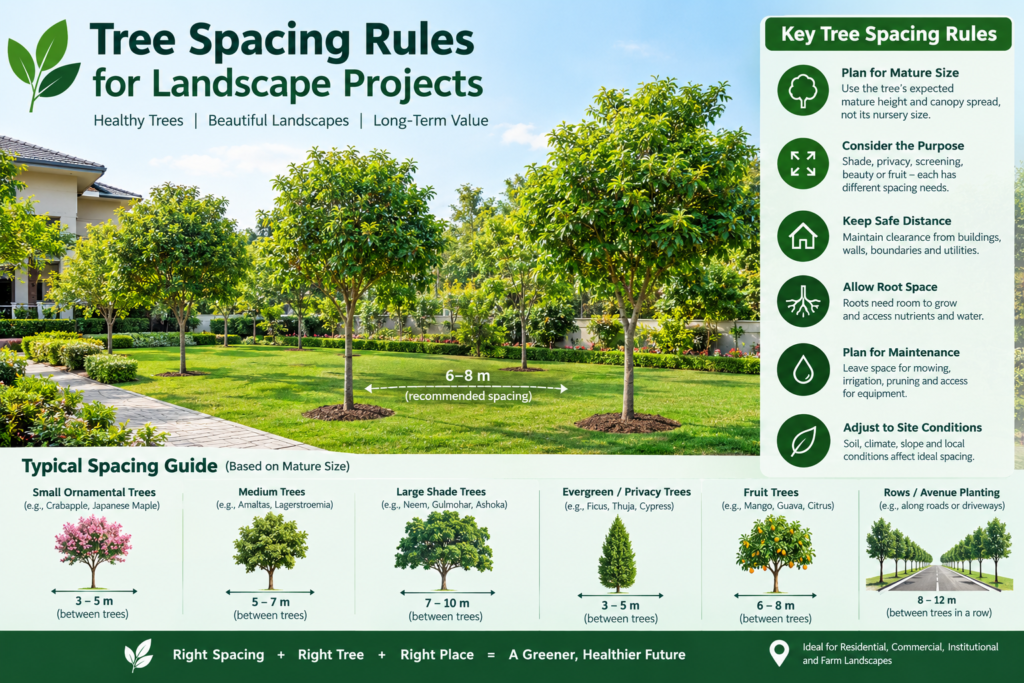
Tree spacing is one of the most important decisions in landscape planning. A newly planted tree may look small, but its mature canopy, trunk, roots, and overall form can occupy a much larger area. Planting trees too close together can create overcrowding, competition for light and water, poor airflow, and higher maintenance requirements. Planting them too far apart can leave unwanted gaps and reduce the visual impact of the landscape.
For this reason, tree spacing rules for landscape projects should be based on the mature characteristics of each tree, the purpose of the planting, and the conditions of the site.
Why Tree Spacing Matters in Landscape Design
Tree spacing affects both the appearance and long-term performance of a landscape.
When trees are planted at appropriate distances, they have better opportunities to develop their natural canopy and root systems. Adequate spacing can also improve light penetration and air movement through the landscape.
Overcrowded trees may eventually require corrective pruning or removal. Extension guidance recommends considering mature plant size rather than the small size of nursery plants when deciding where to place them.
Good spacing can help with:
- Healthy canopy development
- Better sunlight distribution
- Air circulation
- Root-zone development
- Easier maintenance
- Better visual balance
- Reduced competition between plants
- Long-term landscape stability
1. Start With Mature Tree Size
The first rule of tree spacing is simple: do not plan spacing according to the current size of the plant.
Instead, determine the expected mature height and canopy spread.
For example, a young shade tree may occupy only a small area when purchased, but its mature crown could eventually extend several metres in every direction.
A useful planning question is:
How much space will this tree need when it reaches its mature size?
Species references and nursery information can help determine expected mature dimensions. Penn State Extension also emphasizes checking mature size before planting and considering the relationship between plants, buildings, and utilities.
2. Spacing Between Trees
There is no universal distance that works for every landscape tree.
Spacing depends on:
- Mature canopy width
- Tree species
- Growth habit
- Landscape purpose
- Soil conditions
- Available moisture
- Desired visual effect
- Maintenance access
For woodland or production plantings, relatively close spacing may be intentional. For specimen trees in residential landscapes, more generous spacing may be appropriate.
For example, Penn State’s forestry guidance shows that plantation spacing can range from approximately 4 × 4 feet to 12 × 12 feet or more depending on the management objective. These figures should not be copied directly into ornamental landscape designs because forestry and landscape projects have different objectives.
3. Use Canopy Spread as a Planning Reference
Canopy spread is one of the most useful measurements when creating a landscape plan.
Suppose two trees are expected to develop canopies approximately 8 metres wide. Planting them only 3 metres apart would eventually create substantial canopy overlap.
That may be acceptable in some naturalistic or mass-planting designs, but it may be unsuitable when the goal is to maintain individual tree forms.
For specimen planting, allow enough room for the intended mature canopy while considering whether some overlap is desirable.
4. Tree Spacing Along Boundaries
Boundary plantation requires special attention because trees are positioned near property lines, walls, fences, roads, or neighboring properties.
Do not automatically plant a row of trees directly against the boundary.
Instead, consider:
- Mature canopy spread
- Root development
- Branch growth
- Access for pruning
- Wall and fence locations
- Future maintenance
- Local property requirements
A staggered arrangement can sometimes provide better visual coverage than a straight line while giving individual trees more growing space.
5. Spacing Trees From Buildings
Large trees should not be positioned too close to buildings simply because there is empty space beside the structure.
Consider the mature canopy, trunk development, root zone, access requirements, and overhead branches.
The “right tree, right place” principle is particularly important around structures and utility infrastructure.
Before planting, mark:
- House walls
- Foundations
- Driveways
- Walkways
- Drainage lines
- Water pipelines
- Septic systems
- Utility lines
Then select the tree species and location accordingly.
6. Spacing Near Roads and Pathways
Trees beside roads, driveways, and pedestrian paths need additional clearance planning.
Branches should not obstruct movement, visibility, lighting, or access. Trees should also have enough space for healthy root development.
Where vehicles or pedestrians pass nearby, tree form and future branch clearance become important design considerations.
For commercial and institutional landscapes, maintenance vehicles should also be considered before finalizing tree locations.
7. Spacing for Shade Trees
Shade trees generally need more space than small ornamental trees.
The objective is often to develop a broad canopy, so planting several large shade trees very close together can create unnecessary competition.
Penn State Extension notes that mature shade-tree spacing can vary substantially according to species size and planting density, illustrating why a single fixed spacing number is not appropriate for every project.
For residential landscapes, assess the mature canopy and determine whether you want:
- Individual specimen trees
- Connected canopy
- Partial shade
- Full shade
- A natural woodland appearance
The design objective should determine the spacing.
8. Spacing for Avenue and Roadside Planting
Avenue planting often requires consistency.
Trees may be arranged in:
- Single rows
- Double rows
- Alternating patterns
- Formal grids
- Informal groupings
Uniform spacing can create a strong visual rhythm, but the selected distance should still accommodate mature tree size.
Trees growing near overhead utilities require additional planning. Species with mature dimensions incompatible with wires should be avoided or positioned appropriately.
9. Spacing for Group Planting
Not every landscape needs trees planted in a perfect grid.
Group planting can create a more natural appearance. Trees can be arranged in clusters, staggered rows, or irregular formations.
However, irregular design does not mean random planting.
Each tree should still have enough room for its intended mature growth.
A good landscape plan may combine:
Large tree + medium tree + ornamental tree + shrubs + open space
This creates layers while reducing unnecessary competition.
10. Tree Spacing and Maintenance Access
Maintenance is often ignored during the design stage.
A landscape may look attractive immediately after installation but become difficult to maintain when trees mature.
Leave practical access for:
- Mowing
- Irrigation
- Pruning
- Fertilization where required
- Pest inspection
- Equipment movement
- Tree removal if necessary
Modern landscape planning should consider the entire maintenance cycle, not just the planting day.
Common Tree Spacing Mistakes
Planting Too Close
This is one of the most common mistakes. Trees planted too closely may eventually compete for light, water, nutrients, and growing space. Dense planting can also increase maintenance requirements.
Using the Nursery Size as the Spacing Guide
A 1.5-metre tree does not necessarily need only 1.5 metres of space.
Always research its expected mature dimensions.
Ignoring Underground Growth
The visible canopy is only part of the planning equation. Root systems also need appropriate growing conditions and space.
Planting Everything at Equal Distances
Uniform spacing can work for formal designs, but different tree species may have very different mature sizes.
Forgetting Future Development
Driveways, buildings, pathways, drainage systems, and utility installations may change over time. A landscape plan should consider possible future requirements.
A Simple Tree Spacing Formula
There is no universal mathematical formula for every landscape project, but a useful planning framework is:
Required planting area ≈ mature canopy width + clearance requirements + maintenance access
For row planting, you can separately evaluate:
Tree-to-tree spacing + row-to-row spacing
The final dimensions should be adjusted according to species, site conditions, planting purpose, and the desired visual effect.
For production or forestry projects, spacing calculations may also be expressed in trees per acre or hectare. Penn State provides examples showing how row and within-row spacing influence planting density.
Tree Spacing Planning Checklist
Before finalizing a landscape plan, check:
| Factor | Question |
|---|---|
| Mature size | How large will the tree become? |
| Canopy | What is its expected crown spread? |
| Roots | Does the site provide sufficient root-zone space? |
| Buildings | Is the tree positioned safely from structures? |
| Utilities | Are overhead and underground services considered? |
| Purpose | Is the planting for shade, screening, beauty, fruit, or another objective? |
| Access | Can maintenance equipment reach the area? |
| Soil | Does the soil support the selected species? |
| Water | Is adequate irrigation available during establishment? |
| Future growth | Will the landscape still work after 5–10 years? |
Tree Spacing for Landscape Projects in Saharanpur
For landscape projects in Saharanpur and nearby areas, tree spacing should be developed according to the selected species, site dimensions, soil conditions, irrigation availability, and intended landscape function.
For example, a residential garden, farmhouse, institutional campus, roadside plantation, and commercial property may all require different planting arrangements.
Instead of applying the same spacing to every project, create a site-specific plantation layout based on mature tree size and the purpose of each planting zone.
How Anuj Nursery Can Help
Anuj Nursery can help property owners, landscapers, contractors, and project planners select trees for different landscape applications.
Before purchasing trees for a large project, prepare the site dimensions, plantation objectives, approximate quantity, and preferred tree types. A clear planting plan can help reduce unnecessary plant purchases and future maintenance problems.
For larger landscaping projects, tree selection and spacing should ideally be coordinated with the complete landscape layout rather than treated as a separate planting decision.
Conclusion
The most important tree spacing rule is not a fixed number. It is to plan according to the mature tree and the purpose of the landscape.
Consider canopy spread, root-zone requirements, buildings, utilities, pathways, maintenance access, soil, irrigation, and future growth before planting.
A landscape should not be judged only by how full it looks on planting day. The real test is whether the trees still have enough space to grow, remain healthy, and function as intended years later.
Proper spacing turns individual trees into a coordinated landscape system rather than a collection of plants.