Tree plantation can transform a property by adding shade, improving the landscape, supporting biodiversity, and creating a greener environment. However, successful tree plantation requires more than purchasing healthy plants and putting them into the ground.
Many plantation problems begin before planting day. Poor species selection, inadequate spacing, unsuitable locations, weak soil preparation, and unrealistic maintenance plans can affect tree growth for years.
Understanding common tree plantation planning errors can help homeowners, farmers, landscapers, institutions, contractors, and property owners create healthier and more practical plantation projects.
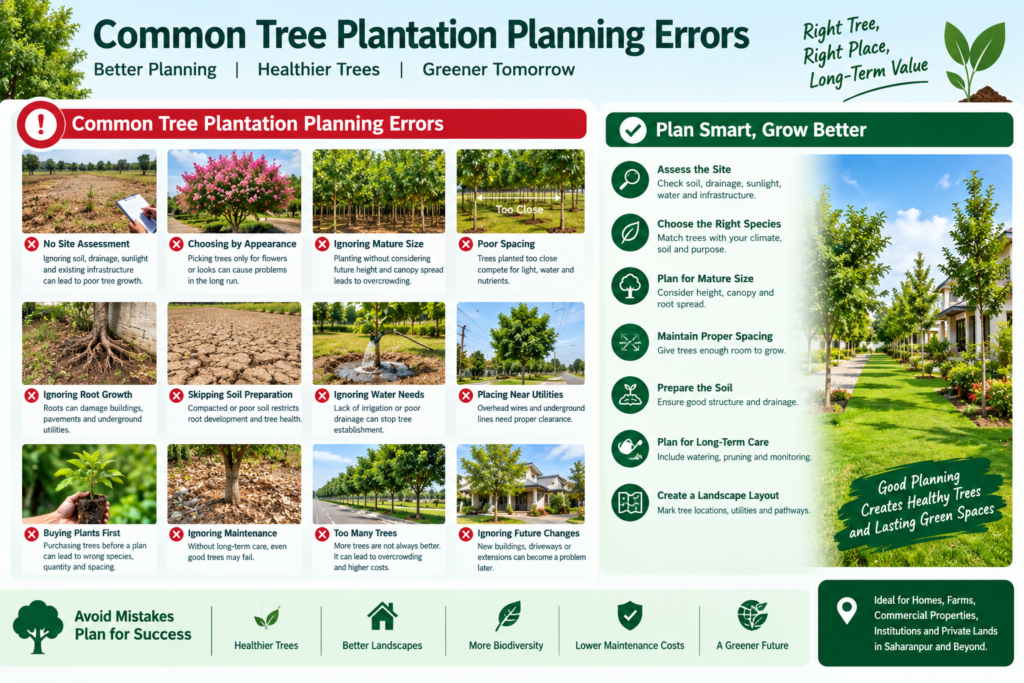
1. Planting Without a Site Assessment
One of the most common mistakes is starting plantation work without properly assessing the site.
Before selecting trees, examine:
- Soil condition
- Drainage
- Sunlight
- Water availability
- Existing vegetation
- Land slope
- Buildings
- Boundary walls
- Roads and pathways
- Underground utilities
- Overhead electrical lines
Without this information, even a suitable tree species may be planted in an unsuitable location.
A basic site assessment should always come before final species selection and planting.
2. Choosing Trees Only for Their Appearance
A tree may look attractive in a nursery but still be unsuitable for a particular property.
Selecting trees only because of their flowers, foliage, height, or current appearance can create long-term problems.
Instead, consider:
Appearance + mature size + climate suitability + soil + water + maintenance + purpose
For example, a large-growing tree may be appropriate for an open farmhouse but unsuitable for a narrow residential garden.
The best tree is not necessarily the most attractive tree. It is the tree that fits the site and its intended function.
3. Ignoring Mature Tree Size
This is one of the most important plantation planning errors.
Young nursery plants occupy very little space, but their mature canopies and root systems may become considerably larger.
Planting trees too close to:
- Houses
- Walls
- Roads
- Pathways
- Utility lines
- Other trees
can create future management problems.
Always plan according to the tree’s expected mature size rather than its current nursery size.
4. Planting Trees Too Close Together
Overcrowding may make a newly planted landscape look full, but the same layout can become problematic as trees mature.
Trees planted too closely may compete for sunlight, water, nutrients, and growing space.
Possible consequences include:
- Weak or uneven growth
- Poor airflow
- Excessive canopy competition
- Increased pruning requirements
- Difficult maintenance
- Reduced visual quality
Tree spacing should be based on species, mature canopy, landscape purpose, and site conditions.
5. Ignoring Root Growth
People often plan only for what they can see above the ground.
However, roots are an essential part of long-term tree development.
Planting trees without considering root-zone requirements can create problems around:
- Foundations
- Pavements
- Drainage systems
- Underground pipes
- Septic systems
- Boundary structures
This does not mean trees should be avoided near all structures. Instead, tree species and planting locations should be selected according to the available root-zone space.
6. Planting Without Considering Soil Conditions
Healthy roots require suitable soil.
Planting directly into heavily compacted, poorly drained, contaminated, or construction-filled soil can restrict establishment.
Before plantation, check:
- Soil structure
- Drainage
- Compaction
- Organic matter
- Moisture conditions
- Rooting depth
Where necessary, improve the planting area before installing trees.
Soil preparation should support long-term root development rather than relying on excessive fertilizer immediately after planting.
7. Ignoring Water Availability
Another common mistake is choosing trees without considering the property’s water supply.
Newly planted trees generally require appropriate moisture while establishing. Water requirements vary by species, season, soil, rainfall, and site conditions.
Before plantation, determine:
- Where irrigation water will come from
- How frequently new trees can be watered
- Whether the soil drains quickly
- Whether the area experiences waterlogging
- How the trees will be managed during dry periods
A plantation plan should be realistic about available water rather than assuming irrigation will always be convenient.
8. Planting at the Wrong Time
Planting timing can influence establishment.
However, there is no single planting date that works for every tree and every location.
Consider:
- Local rainfall
- Soil moisture
- Temperature
- Species requirements
- Irrigation availability
- Weather conditions
In many parts of India, the monsoon can provide favorable moisture for establishing suitable trees, but local conditions should still be evaluated.
9. Failing to Plan Tree Spacing
Tree spacing should be designed before plants are purchased.
A plantation layout should show approximate positions and spacing rather than relying on decisions made during installation.
Consider spacing between:
- Trees
- Rows
- Buildings
- Boundaries
- Roads
- Pathways
- Utility infrastructure
Proper spacing makes the plantation easier to manage as trees mature.
10. Planting Every Tree in the Same Pattern
Uniform planting is useful for some formal designs, but it is not always appropriate.
Different species have different mature dimensions and growth habits.
A mixed landscape may require:
- Large shade trees
- Medium trees
- Ornamental trees
- Fruit trees
- Shrubs
- Groundcovers
- Open areas
Instead of forcing every tree into the same spacing pattern, develop planting zones according to the purpose and characteristics of each species.
11. Ignoring Existing Infrastructure
Plantation plans sometimes overlook infrastructure that already exists underground or overhead.
Before digging, identify the location of:
- Water pipes
- Drainage lines
- Electrical cables
- Gas or other service lines where applicable
- Septic systems
- Foundations
- Irrigation systems
Overhead wires should also be considered when selecting mature tree height and canopy characteristics.
12. Buying Trees Before Creating a Plantation Plan
Purchasing plants first and figuring out where they will go later can create unnecessary problems.
It may result in:
- Too many plants
- Wrong species
- Inconsistent spacing
- Insufficient planting space
- Unnecessary transportation
- Higher project costs
A better process is:
Site assessment → planting objective → species selection → layout → quantity calculation → plant purchase → plantation
This sequence reduces avoidable errors.
13. Ignoring Long-Term Maintenance
Plantation planning should not stop after installation.
Trees may require:
- Watering
- Mulching
- Weed control
- Pest monitoring
- Structural support
- Pruning when appropriate
- Replacement of failed plants
A landscape that cannot be maintained properly may lose much of its intended value.
Before planting, estimate the time, labor, water, and equipment required for long-term care.
14. Selecting Trees Without Considering the Landscape Purpose
Different projects have different goals.
A boundary plantation may prioritize screening and privacy. A residential garden may prioritize shade and appearance. A roadside project may require trees with suitable form and clearance. An agricultural property may have different objectives altogether.
Define the primary purpose before selecting species.
This prevents the common mistake of using the same tree list for every project.
15. Planting Too Many Trees
More trees do not automatically mean a better plantation.
Excessive planting can lead to:
- Overcrowding
- Competition for resources
- Higher maintenance
- Poor canopy development
- Difficult access
- Increased replacement requirements
The objective should be to create a healthy and functional plantation rather than simply maximizing the number of trees.
16. Ignoring Future Property Changes
A plantation may perform well today but become problematic if the property changes.
Before planting, consider possible future:
- Buildings
- Extensions
- Driveways
- Parking areas
- Pathways
- Drainage work
- Utility installations
Trees are long-term landscape elements, so plantation planning should account for foreseeable changes.
17. Choosing Trees Based Only on Fast Growth
Fast-growing trees can provide shade and visual impact relatively quickly, but growth rate alone should not determine selection.
Evaluate:
- Mature size
- Structural characteristics
- Lifespan
- Rooting behavior
- Maintenance requirements
- Site suitability
A slower-growing tree may sometimes be more appropriate for a long-term landscape objective.
18. Neglecting Plant Quality
Even the right species can perform poorly if the planting material is weak or unhealthy.
Before purchasing trees, inspect:
- Foliage
- Stem condition
- Root health
- Pest or disease symptoms
- Overall structure
- Container or root condition
Good plantation planning should include both species selection and plant quality.
19. Failing to Create a Plantation Budget
Cost planning is often overlooked.
The actual project cost can include more than the purchase price of trees.
Consider:
- Plants
- Soil preparation
- Transport
- Planting labor
- Irrigation
- Mulching
- Tree supports
- Maintenance
- Replacement plants
- Future pruning
Creating a complete budget before installation can prevent unexpected expenses.
20. Treating Every Property the Same
A residential garden, farmhouse, commercial development, school, industrial site, roadside landscape, and institutional campus have different requirements.
Using one standard plantation formula for every property is a planning error.
A successful plantation plan should be site-specific.
Common Tree Plantation Planning Errors Checklist
| Error | Better Approach |
|---|---|
| No site assessment | Evaluate soil, sunlight, drainage, and infrastructure |
| Choosing by appearance | Match species to site conditions |
| Ignoring mature size | Plan for future tree growth |
| Trees too close together | Calculate mature spacing |
| Ignoring roots | Provide suitable root-zone space |
| Poor soil preparation | Improve unsuitable planting areas |
| Ignoring water | Plan irrigation and establishment care |
| Poor planting timing | Consider local weather and soil moisture |
| No plantation layout | Create a planting plan before purchase |
| Too many trees | Calculate practical planting density |
| Ignoring maintenance | Plan long-term care |
| No budget | Include installation and maintenance costs |
| Ignoring future changes | Consider future property development |
How to Avoid Tree Plantation Planning Errors
A practical plantation workflow can be divided into eight stages:
1. Assess the site
Understand soil, sunlight, drainage, water, and existing infrastructure.
2. Define the objective
Decide whether the plantation is for shade, screening, beauty, fruit, biodiversity, boundary planting, or another purpose.
3. Select appropriate species
Match tree characteristics with local conditions and available space.
4. Plan mature spacing
Consider canopy spread, root growth, and maintenance access.
5. Create the layout
Mark tree positions, boundaries, structures, paths, and utilities.
6. Calculate quantities and costs
Determine how many plants are actually required.
7. Prepare the site
Address soil, drainage, irrigation, and other site limitations.
8. Plan long-term maintenance
Prepare for watering, monitoring, pruning, and replacement where necessary.
Tree Plantation Planning in Saharanpur
For properties in Saharanpur and nearby areas, plantation planning should consider the local seasonal climate, soil conditions, summer temperatures, monsoon rainfall, irrigation availability, and the size of the available planting area.
A tree suitable for an open agricultural property may not be appropriate for a compact residential landscape.
For this reason, plantation projects in Saharanpur should be planned according to the actual property rather than relying on a generic tree list.
How Anuj Nursery Can Help
Anuj Nursery can help homeowners, landscapers, contractors, institutions, and property owners explore tree options for plantation and landscaping projects in Saharanpur and nearby areas.
Before ordering plants for a larger project, prepare the site dimensions, plantation purpose, preferred tree categories, approximate quantity, and basic layout.
This makes it easier to coordinate tree selection, spacing, quantities, and long-term maintenance.
Conclusion
Most tree plantation problems do not begin after planting. They begin with planning decisions made before the first tree goes into the ground.
Ignoring mature tree size, choosing unsuitable species, planting too closely, overlooking roots and utilities, failing to assess soil, and underestimating maintenance can create problems that become expensive to correct later.
The solution is straightforward: assess the site, define the purpose, choose suitable trees, plan mature spacing, calculate quantities, prepare the soil, and think about long-term maintenance.
A successful plantation is not simply one where many trees are planted. It is one where the right trees have enough space and suitable conditions to grow successfully for years.