
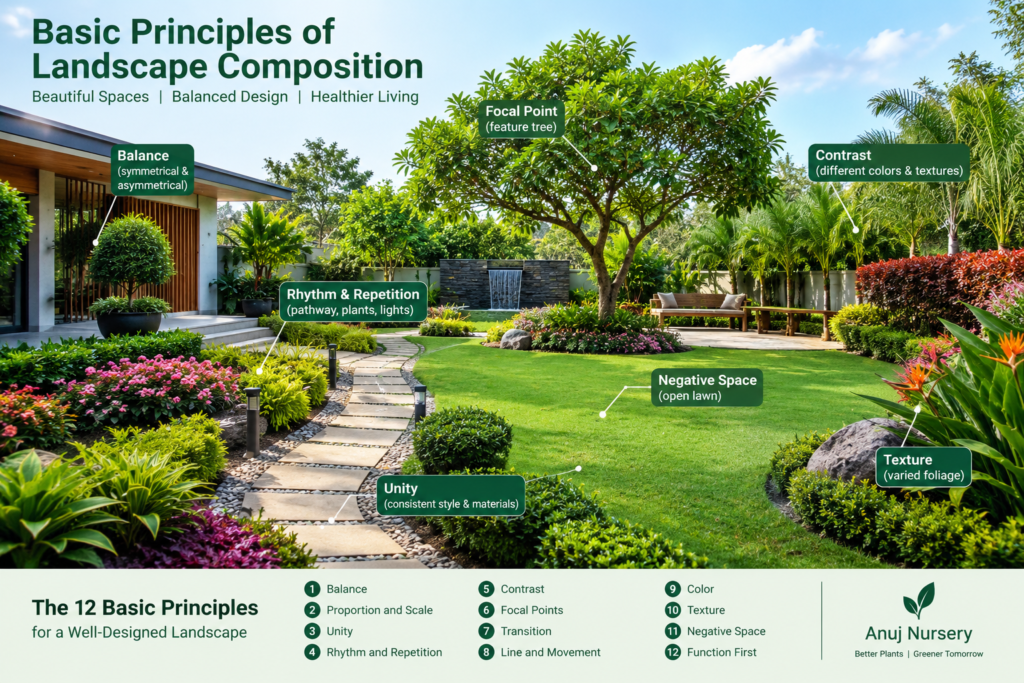
A beautiful landscape is not created simply by placing attractive plants around a property. Good landscape design depends on how plants, trees, pathways, structures, colors, textures, and open spaces work together. Understanding the basic principles of landscape composition helps homeowners, designers, and landscapers create outdoor spaces that look organized, balanced, functional, and visually appealing.
Whether you are planning a residential garden, commercial property, institutional landscape, or large outdoor project, these principles provide a practical foundation for making better design decisions.
What Is Landscape Composition?
Landscape composition refers to the way different elements of a landscape are arranged and connected visually. It determines how people experience a garden when they enter, walk through, or view it from a building.
A well-composed landscape usually has a clear structure. Trees may provide height, shrubs can create layers, flowering plants can add seasonal color, and pathways can guide movement through the space.
The goal is not to make every part of the garden identical. Instead, the objective is to create relationships between different elements so the entire landscape feels intentional.
1. Balance
Balance is one of the most important principles of landscape composition. It creates visual stability and prevents one side of a landscape from appearing excessively heavy.
There are two common types of balance:
Symmetrical balance uses similar plants, shapes, or features on both sides of a central line. It is commonly used in formal gardens, entrances, and institutional landscapes.
Asymmetrical balance uses different elements that have similar visual weight. For example, a large tree on one side may be balanced by a group of smaller trees and shrubs on the other.
For modern residential landscapes, asymmetrical balance can create a more natural appearance.
2. Proportion and Scale
Proportion describes the relationship between different landscape elements, while scale considers their size in relation to the surrounding space.
A very large tree planted beside a tiny pathway may look disproportionate. Similarly, small shrubs can disappear visually in a large open lawn.
When selecting plants, consider:
- Property size
- Building height
- Garden dimensions
- Pathway width
- Mature plant size
- Viewing distance
- Human movement
Remember that plants should be selected according to their mature size, not just their nursery size.
3. Unity
Unity makes different landscape elements feel like parts of one complete design.
A landscape can achieve unity by repeating certain characteristics, such as:
- Similar plant forms
- Consistent colors
- Repeated materials
- Matching hardscape elements
- Related architectural styles
- Repeated planting patterns
However, too much repetition can make a garden boring. The goal is to create visual relationships without eliminating variety.
4. Rhythm and Repetition
Rhythm guides the eye through a landscape.
Repeating plants, trees, paving patterns, lighting elements, or garden structures can create a predictable visual sequence.
For example, planting the same type of ornamental tree at regular intervals along a driveway can create rhythm while also strengthening the property’s entrance.
Repetition should be controlled. Randomly repeating too many plants can make the landscape feel cluttered rather than organized.
5. Contrast
Contrast creates visual interest by placing different elements together.
Examples include:
- Light and dark foliage
- Fine and broad leaves
- Tall and low plants
- Smooth and rough textures
- Bright flowers against green foliage
- Hardscape against soft planting
Contrast is particularly useful for creating focal areas. However, excessive contrast can make a landscape visually chaotic.
A good design uses contrast strategically rather than everywhere.
6. Focal Points
A focal point is an element that naturally attracts attention.
Examples include:
- An ornamental tree
- Water feature
- Sculpture
- Large flowering plant
- Garden entrance
- Feature wall
- Specimen palm
- Seating area
A focal point should support the overall design rather than compete with every other element.
In larger landscapes, several focal points may be used, but they should have a clear hierarchy.
7. Transition
Transition creates a smooth visual movement from one area to another.
Instead of suddenly changing from a low groundcover area to very tall trees, designers can introduce intermediate layers such as shrubs and medium-height plants.
A typical planting transition might look like:
Groundcovers → Small Plants → Shrubs → Small Trees → Large Trees
This layered approach can make a garden feel more natural and visually connected.
8. Line and Movement
Lines influence how people look at and move through a landscape.
Straight lines often create a formal and structured appearance. Curved lines can produce a softer and more natural feeling.
Pathways, lawn edges, planting beds, retaining walls, fences, and tree arrangements can all create visual lines.
When planning a garden, think about where you want visitors to look and how you want them to move through the property.
9. Color
Color can dramatically influence the character of a landscape.
Green provides the primary visual foundation in most gardens, while flowers and foliage introduce additional colors.
When selecting colors, consider:
- Flowering seasons
- Foliage color
- Building colors
- Existing hardscape
- Sunlight conditions
- Desired garden atmosphere
Instead of using many unrelated colors, choose a controlled palette and repeat selected colors throughout the landscape.
10. Texture
Texture refers to how coarse or fine plants and landscape materials appear.
Large leaves generally create a bold or coarse appearance, while small leaves and fine grasses create a softer visual texture.
Combining different textures can make a planting bed more interesting. For example, a broad-leaved plant can be paired with fine ornamental grass and medium-textured shrubs.
Texture becomes especially important when flower colors are limited.
11. Negative Space
Empty space is not wasted space. In landscape composition, open areas help important features stand out.
Lawns, courtyards, patios, pathways, and clear spaces between planting groups can provide visual breathing room.
Without sufficient negative space, a landscape can feel overcrowded even when every individual plant is attractive.
12. Function Should Come Before Decoration
A landscape must work as well as it looks.
Before selecting plants, determine how the space will be used. Consider:
- Walking routes
- Parking
- Seating
- Children’s play areas
- Privacy
- Shade
- Maintenance access
- Drainage
- Irrigation
- Security
Once functional requirements are understood, decorative planting can be incorporated around them.
Applying Landscape Composition to Real Projects
For a successful landscape, begin with the site rather than the plant list. Study sunlight, soil, drainage, existing trees, building architecture, available space, and maintenance requirements.
Then establish major zones such as entrance areas, lawns, planting beds, pathways, seating areas, and service spaces.
After the structure is established, select plants according to their mature size, climate suitability, maintenance requirements, and visual role.
For homeowners and landscape projects in Saharanpur and nearby areas, Anuj Nursery can be considered when planning plant selections for residential and commercial landscapes. The right plant selection should always follow the design requirements of the site rather than simply choosing plants because they look attractive at the nursery.
Frequently Asked Questions
What are the basic principles of landscape composition?
The basic principles include balance, proportion and scale, unity, rhythm, repetition, contrast, focal points, transition, line, color, texture, and effective use of negative space.
Why is balance important in landscape design?
Balance creates visual stability. It prevents one area of a landscape from appearing excessively heavy or disconnected from the rest of the design.
How does repetition improve a landscape?
Repetition creates rhythm and helps connect different parts of a garden. Repeated plants, materials, colors, or forms can make a landscape feel more cohesive.
What is a focal point in landscape design?
A focal point is a feature designed to attract attention, such as a specimen tree, ornamental plant, water feature, sculpture, entrance, or architectural element.
Should landscape design prioritize beauty or functionality?
Both are important, but functionality should be established first. A beautiful landscape that has poor circulation, drainage, maintenance access, or inappropriate plant selection will eventually become difficult to manage.
Conclusion
Understanding the basic principles of landscape composition gives you a stronger foundation for planning attractive and functional outdoor spaces. Balance creates stability, proportion keeps elements appropriately scaled, repetition establishes rhythm, contrast adds interest, and focal points direct attention.
The strongest landscapes do not depend on expensive materials or large numbers of plants. They depend on thoughtful relationships between space, plants, structures, movement, and human use.
Whether you are developing a small home garden or planning a large commercial landscape, applying these principles before planting can reduce mistakes and produce a more cohesive result.