North India has excellent potential for commercial fruit farming because of its diverse climate, fertile soils, and growing demand for fresh fruits. States such as Uttar Pradesh, Punjab, Haryana, Uttarakhand, Rajasthan, and parts of Himachal Pradesh support several profitable fruit crops. However, choosing the right fruit plants is one of the most important decisions for farmers planning a commercial orchard.
Selecting varieties according to climate, soil, water availability, market demand, and expected harvesting season can help create a productive and sustainable orchard. Anuj Nursery provides quality fruit plants suitable for different farming and orchard requirements.
Why Choose Commercial Fruit Plants Carefully?
Commercial fruit farming requires a long-term investment. A farmer may spend several years developing an orchard before getting maximum production. Therefore, plant quality and variety selection should not be overlooked.
Healthy nursery plants generally establish more easily after transplantation and can provide a better foundation for future orchard growth. Farmers should also consider fruit size, taste, shelf life, market demand, disease tolerance, and harvesting period before selecting a variety.
Top Commercial Fruit Plants for North India
1. Mango
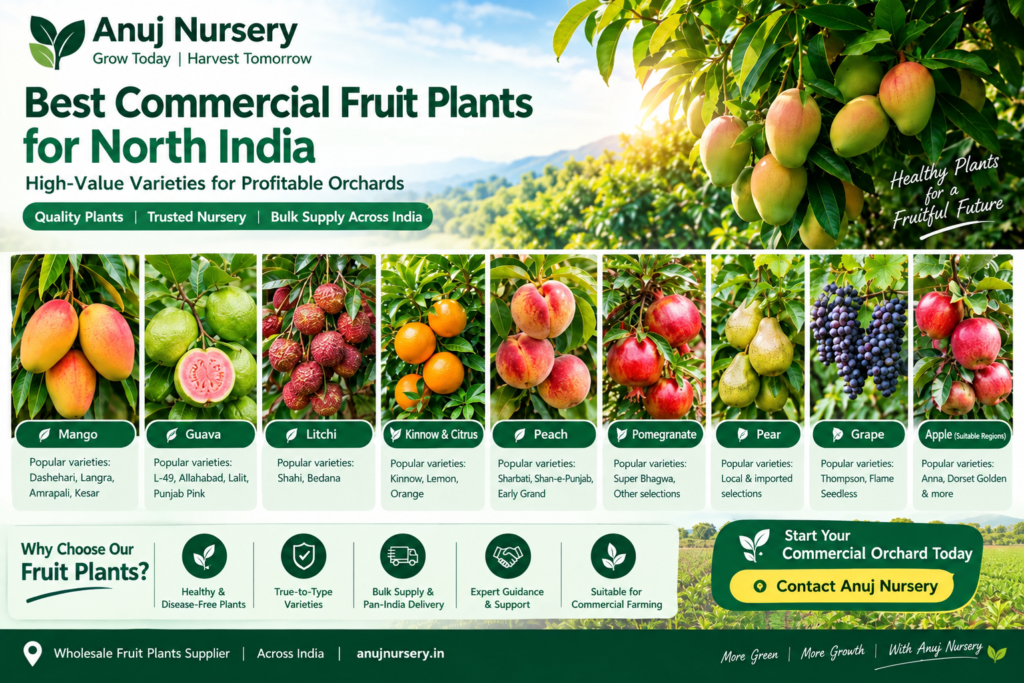
Mango is one of the most popular commercial fruit crops in North India. Varieties such as Dashehari, Langra, Chausa, Amrapali, and Mallika are widely recognized for cultivation in suitable regions.
Mango trees can become productive orchard trees with proper irrigation, nutrition, pruning, and pest management. Their strong consumer demand makes mango an important choice for commercial fruit growers.
2. Guava
Guava is another excellent option for farmers in North India. It is relatively adaptable and can perform well under suitable soil and climatic conditions.
Popular varieties include Allahabad Safeda, Lalit, Shweta, and Lucknow-49. Guava can be suitable for both fresh fruit markets and processing. With proper orchard management, farmers can target different harvesting periods and market opportunities.
3. Pomegranate
Pomegranate has gained popularity among commercial fruit growers because of its attractive market value and consumer demand. It performs best where drainage is good and irrigation can be managed efficiently.
Varieties such as Bhagwa are widely cultivated commercially. Farmers should select planting material according to their local climate and water conditions.
4. Aonla
Aonla, also known as Indian gooseberry, is particularly useful for commercial cultivation because its fruits are used in food, beverages, Ayurveda-related products, pickles, and processing.
Varieties such as NA-7, Chakaiya, and Krishna can be considered for suitable regions. Aonla trees are also valued for their relatively hardy nature and long productive life.
5. Lemon and Other Citrus Plants
Lemon is an attractive option for farmers who want a fruit crop with regular household and commercial demand. Suitable citrus varieties can perform well in North Indian conditions when soil drainage, irrigation, nutrition, and disease management are handled properly.
Kagzi lemon is a commonly known type, while other citrus options can be selected based on local conditions and market requirements.
6. Peach
Peach can be suitable for specific regions of North India, particularly areas with appropriate winter conditions. Different peach varieties have different chilling requirements, so farmers should choose varieties according to their local climate.
Peach trees can produce attractive fruits and may provide good market opportunities when grown in suitable locations with proper orchard management.
7. Plum
Plum is another fruit crop that can be considered for suitable parts of North India. Varieties differ in chilling requirements, fruit characteristics, and harvesting periods.
Farmers should select varieties after considering local winter conditions, soil type, irrigation facilities, and nearby market demand.
8. Ber
Ber is a hardy fruit crop that can tolerate relatively dry conditions better than many other fruit trees. It can be useful for farmers looking for fruit crops suitable for areas where water availability may be limited.
Improved ber varieties can provide better fruit quality and commercial opportunities when managed properly.
Factors to Consider Before Starting a Commercial Orchard
Before purchasing fruit plants, farmers should evaluate several important factors:
- Climate: Select varieties suitable for local temperature and winter conditions.
- Soil: Conduct a soil test before plantation and check drainage.
- Water: Ensure reliable irrigation, especially during establishment and fruit development.
- Market Demand: Study local wholesale markets, retailers, processors, and direct consumers.
- Plant Quality: Purchase healthy and properly identified nursery plants.
- Spacing: Plan tree spacing according to the fruit species and expected canopy size.
- Pollination: Some fruit crops may require compatible pollinizer varieties.
- Disease Management: Choose suitable planting material and follow preventive orchard practices.
- Harvesting Period: Different varieties can help spread production across different market windows.
Why Quality Nursery Plants Matter
The quality of planting material has a direct impact on orchard establishment. Weak, unhealthy, or incorrectly identified plants can create problems later and may increase replacement and management costs.
When purchasing commercial fruit plants, farmers should ask about the plant variety, age, growing conditions, and suitability for their region. Buying from a reliable nursery can make the plantation process more organized.
Anuj Nursery offers a range of fruit plants for farmers, orchard owners, landscaping projects, and home growers. Farmers can select fruit plants according to their plantation size, climate, soil, and commercial objectives.
Final Thoughts
Commercial fruit farming in North India can offer diverse opportunities when farmers select suitable crops and manage their orchards carefully. Mango, guava, pomegranate, aonla, lemon, peach, plum, and ber are among the fruit plants that can be considered for suitable regions.
The right variety is only the first step. Proper land preparation, quality planting material, irrigation, nutrition, pruning, pest management, and marketing planning are equally important. Before establishing a large orchard, farmers should evaluate their local growing conditions and market requirements carefully.
For quality fruit plants and nursery guidance, Anuj Nursery can be considered as a source for commercial and plantation requirements.
AEO – Frequently Asked Questions
Which fruit plants are suitable for commercial farming in North India?
Mango, guava, aonla, pomegranate, lemon, ber, peach, and plum can be suitable depending on the local climate, soil, water availability, and market conditions.
Which mango varieties are popular in North India?
Dashehari, Langra, Chausa, Amrapali, and Mallika are well-known mango varieties suitable for consideration in appropriate regions.
What should farmers check before buying fruit plants?
Farmers should check the variety, plant health, nursery quality, climate suitability, soil requirements, irrigation needs, and expected market demand.
Is guava suitable for commercial orchards?
Yes, guava can be grown commercially in suitable North Indian conditions. Variety selection, spacing, irrigation, nutrition, and orchard management are important for productive cultivation.