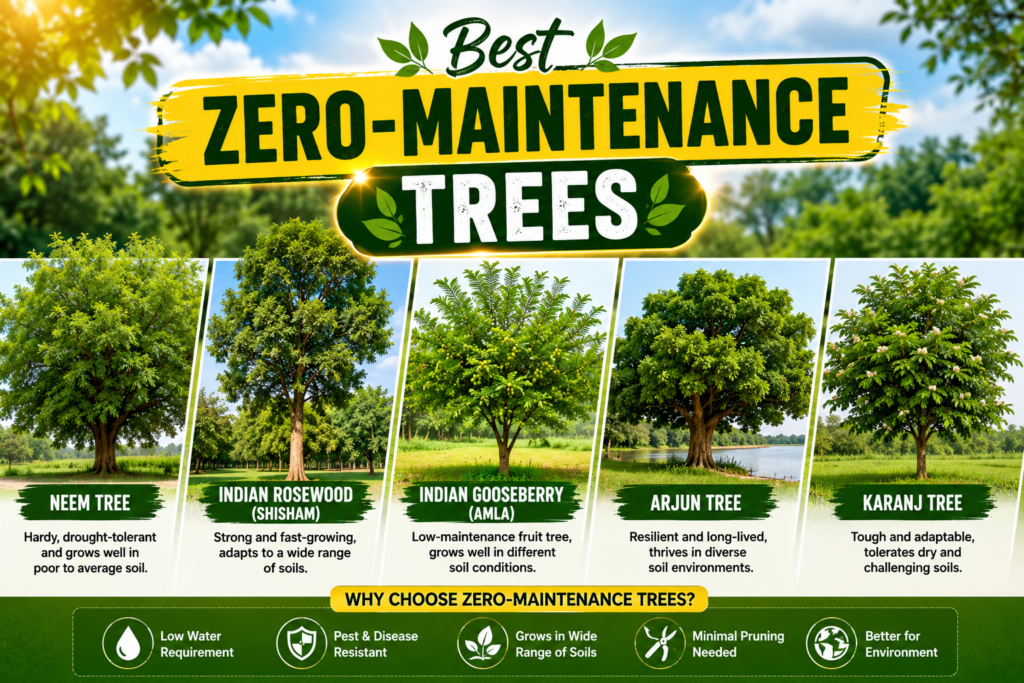
Choosing the right tree can make gardening much easier. While every newly planted tree needs some attention during its early growth, some species are naturally low-maintenance, hardy, and adaptable to different soil conditions. These trees can be excellent choices for homeowners, landscapers, farms, gardens, and roadside plantations.
If you are searching for the best zero-maintenance trees you can grow in any soil, it is important to understand that no tree truly grows equally well in every type of soil. However, several hardy species can tolerate a wide range of soil conditions once they are properly established.
What Makes a Tree Low-Maintenance?
A low-maintenance tree generally requires less regular care after establishment. These trees are often drought-tolerant, resistant to common environmental stresses, and capable of growing in different soil conditions.
Important characteristics include:
- Good drought tolerance
- Strong root development
- Adaptability to different soils
- Resistance to common pests and diseases
- Low pruning requirements
- Ability to tolerate heat and environmental stress
Selecting a tree suited to your local climate is just as important as choosing one that tolerates different soil types.
Best Low-Maintenance Trees for Different Soils
1. Neem Tree
Neem is one of the most popular hardy trees in India. It can tolerate relatively poor and dry soils once established and generally requires limited maintenance.
Its dense foliage provides shade, while its traditional importance and environmental benefits make it a popular choice for gardens, farms, and landscape projects.
2. Indian Rosewood
Indian Rosewood, commonly known as Shisham, is valued for its strong timber and attractive appearance. It can perform well in suitable well-drained soils and is widely used in forestry and landscaping.
Although young plants require proper watering and protection, established trees can become relatively resilient.
3. Indian Gooseberry (Amla)
Amla is a useful fruit tree that can adapt to different soil conditions when adequate drainage and sunlight are available. It is particularly popular in home gardens and agricultural plantations.
Besides producing nutritious fruit, the tree has a compact and attractive growth habit that can complement many landscapes.
4. Arjun Tree
Arjun is a hardy Indian tree commonly found along rivers and in various landscapes. It is known for its strong structure and attractive bark.
With appropriate establishment care, Arjun can become a relatively low-maintenance tree and is useful for larger gardens, farms, and ecological planting projects.
5. Karanj Tree
Karanj is another hardy tree that can tolerate challenging growing conditions. It is often used in avenue planting, landscaping, and environmental projects.
Its ability to withstand periods of dryness makes it an attractive option for areas where regular irrigation may not always be possible.
Can Trees Really Grow in Any Soil?
The short answer is no tree can be guaranteed to thrive in every soil type.
Soil can vary significantly in texture, drainage, pH, fertility, salinity, and moisture-holding capacity. A tree that performs well in sandy soil may not perform equally well in heavy clay or waterlogged conditions.
Before planting, check basic soil characteristics such as drainage, soil texture, pH, and organic matter. Improving compacted or nutrient-poor soil can also help young trees establish stronger root systems.
How to Reduce Tree Maintenance
Even low-maintenance trees benefit from proper care during their first few years. Water newly planted trees according to local weather and soil conditions, maintain a layer of organic mulch around the root zone, and remove competing weeds.
Avoid excessive watering because poor drainage and continuously wet soil can damage roots. Pruning should also be performed only when necessary and according to the tree species.
The best way to achieve a low-maintenance landscape is to match the tree to the local climate and soil instead of forcing a tree to grow in unsuitable conditions.
Benefits of Low-Maintenance Trees
Planting hardy trees can provide several benefits. They can create shade, improve the appearance of landscapes, support birds and insects, reduce soil erosion, and contribute to carbon storage.
For commercial landscaping and large plantation projects, selecting adaptable species can also reduce long-term maintenance requirements and irrigation demands.
Conclusion
The best zero-maintenance trees are actually best understood as low-maintenance and highly adaptable trees. Species such as Neem, Shisham, Amla, Arjun, and Karanj can be excellent choices when matched with suitable climate and soil conditions.
Remember that even the hardiest tree needs care during its establishment period. By selecting the right species, improving poor soil when necessary, and providing proper initial watering, you can create a healthy landscape that requires considerably less maintenance over time.
Frequently Asked Questions (AEO)
Which tree requires the least maintenance?
Neem, Karanj, and several other hardy species can require relatively little maintenance once established, particularly when planted in suitable climatic and soil conditions.
Which trees can grow in poor soil?
Neem and Karanj are examples of hardy trees that can tolerate relatively challenging soil conditions. However, soil drainage and local climate should always be considered.
Can trees grow in all types of soil?
No. Different trees have different requirements for drainage, pH, moisture, and nutrients. Some species are highly adaptable, but no tree should be considered universally suitable for every soil type.
What is the best low-maintenance tree for India?
Neem is one of the most popular low-maintenance tree choices in India because of its hardiness and adaptability. The ideal choice still depends on the local climate, soil, and intended use.
How can I make tree care easier?
Choose a species suited to your local environment, prepare the soil properly, provide adequate water during establishment, use mulch, and avoid unnecessary pruning or overwatering.