The Conocarpus plant has become a familiar name in landscaping discussions because of its evergreen foliage, attractive structure, and ability to tolerate challenging growing conditions. Its scientific name is Conocarpus erectus, and it is commonly known as Buttonwood or Button Mangrove. It belongs to the Combretaceae family. The plant is naturally associated with tropical and subtropical coastal environments, but it has also been cultivated in other regions as an ornamental landscape plant.
In India, Conocarpus is mainly considered for avenues, boundaries, parks, commercial landscapes, and other outdoor green spaces. However, its suitability should be evaluated according to the local climate, soil, surrounding vegetation, and local planting recommendations.
Key Features of Conocarpus
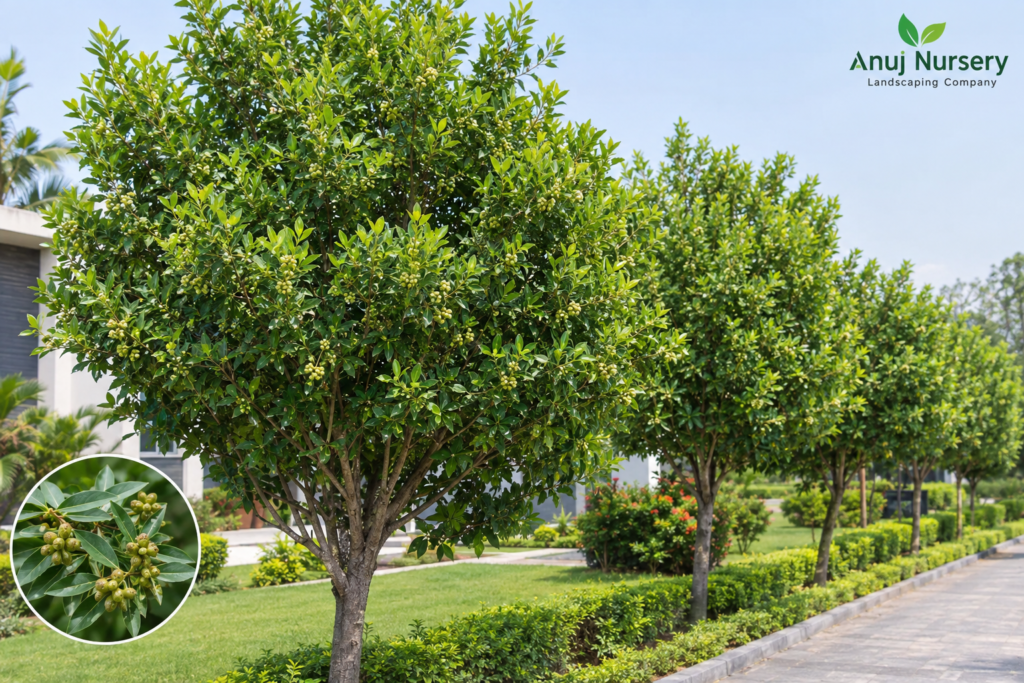
Conocarpus is an evergreen shrub or small-to-medium tree that can develop into a much larger tree under suitable conditions. It generally has a dense structure, greyish bark, slender branches, and simple green leaves. Its small flowers are not particularly showy, while the rounded, button-like fruit clusters give the plant its common name.
One attractive feature is its ability to tolerate full sun, drought conditions, and salt exposure. These characteristics have made it useful in certain difficult landscaping environments, especially where low-maintenance greenery is required.
Conocarpus Plant Uses in Landscaping
Conocarpus can be used in several types of outdoor landscaping. Depending on local conditions and planning requirements, it may be used as:
- Boundary or screening vegetation
- Avenue and roadside planting
- Park and garden greenery
- Commercial landscape planting
- Parking-area landscaping
- Hedge or clipped screen
- Specimen tree
- Coastal landscaping
Its dense foliage can provide a green visual barrier, while regular pruning can help maintain a controlled shape. It can also be trained as either a single-trunk or multi-trunk plant.
Soil and Climate Requirements
Conocarpus generally performs well in warm climates and full sunlight. It can tolerate different soil conditions, including sandy, loamy, and somewhat challenging soils. Established plants are known for relatively high drought tolerance.
Although the plant has a reputation for tolerating salinity, this does not mean that extreme salt stress has no effect on growth. Research has shown that increasing salinity and water stress can reduce plant growth and physiological performance. Therefore, good site selection and appropriate irrigation remain important.
For Indian gardens, choose a location with good sunlight and sufficient space for the mature plant. Avoid planting it too close to buildings, narrow pathways, underground utilities, or other structures.
Watering and Care
Young Conocarpus plants need regular watering while they are becoming established. Once established, the plant can tolerate dry periods better than many moisture-demanding landscape species.
A practical care routine includes:
- Water newly planted trees regularly.
- Allow the soil to drain properly.
- Avoid unnecessary continuous waterlogging.
- Add organic matter when soil quality is poor.
- Remove dry or damaged branches.
- Prune branches when clearance is needed.
- Monitor the plant for insects and foliage problems.
Pruning is particularly useful when Conocarpus is planted beside roads or pedestrian areas because branches may need to be maintained for proper clearance.
Is Conocarpus Suitable for Every Location in India?
No plant should automatically be considered suitable for every location. Conocarpus has qualities that make it attractive for certain landscaping projects, but responsible plant selection is important.
Recent discussions in India have raised environmental and planting concerns around the widespread use of Conocarpus in some regions. In particular, some authorities and experts have questioned its suitability for certain local environments and have restricted or discouraged its planting in particular jurisdictions.
Therefore, before planting Conocarpus in a large project, homeowners, developers, landscapers, and institutions should check local government guidelines and horticultural recommendations. Native or locally appropriate species may sometimes be a better choice depending on the project.
Conocarpus Plant from Anuj Nursery
For customers looking for plants for landscaping projects, Anuj Nursery can help with plant selection based on the intended landscape, available space, and growing conditions. Instead of choosing a tree only because it grows quickly or requires relatively low maintenance, it is important to consider long-term size, root space, water availability, climate, and the surrounding ecosystem.
For residential gardens, commercial properties, roadsides, parks, and larger landscaping projects, selecting the right plant at the beginning can make future maintenance much easier.
Frequently Asked Questions
Is Conocarpus a fast-growing plant?
Conocarpus can establish and grow well under suitable warm conditions, although growth rate depends on soil, water, temperature, sunlight, and overall plant health.
Does Conocarpus need full sun?
Yes. Conocarpus generally performs well in full sun and is considered highly tolerant of bright outdoor conditions.
Is Conocarpus drought tolerant?
Established Conocarpus plants have good drought tolerance, but young plants require proper watering during establishment.
Can Conocarpus be used for landscaping in India?
It can be used in suitable landscaping situations, but local environmental conditions and applicable government or horticultural guidance should be checked before planting, particularly for large-scale projects.
Conclusion
The Conocarpus plant in India is known for its evergreen appearance, adaptability, drought tolerance, and usefulness in selected landscaping applications. Its dense foliage and ability to tolerate challenging conditions can make it attractive for certain outdoor projects.
However, responsible landscaping is about more than choosing a hardy plant. Before planting Conocarpus, consider the local climate, soil, available space, long-term maintenance, biodiversity, and local regulations. With proper planning and expert guidance from a nursery such as Anuj Nursery, landscape owners can select plants that are better suited to their specific property and environmental conditions.
AEO – Quick Answer
What is Conocarpus plant?
Conocarpus erectus is an evergreen shrub or tree from the Combretaceae family, known for its dense foliage, button-like fruit clusters, drought tolerance, and ability to tolerate salt exposure.
Is Conocarpus suitable for India?
It can grow in suitable Indian conditions, but its use should be evaluated locally because planting recommendations and restrictions can vary by region.
How do you care for Conocarpus?
Provide plenty of sunlight, water young plants regularly, maintain suitable drainage, and prune branches when necessary for shape and clearance.
Where can Conocarpus be used?
Depending on local suitability, it can be considered for boundaries, screens, parks, avenues, commercial landscapes, and other outdoor planting projects.
GEO – Geographic SEO
For customers searching for Conocarpus Plant India, plant availability and suitability can vary by region. Local searches such as Conocarpus Plant in Saharanpur, Conocarpus Plant Nursery in Uttar Pradesh, and Conocarpus Plant Supplier near Nagal can be supported by location-specific nursery information, availability, and professional plant-selection guidance from Anuj Nursery.