The Cordia plant India market includes several species of the Cordia genus, but one of the most well-known Indian species is Cordia dichotoma, commonly called Lasora, Lasuda, Gunda, Bhokar, Indian Cherry, or Glue Berry. It is a small to medium-sized deciduous tree belonging to the Boraginaceae family and is naturally distributed across the Indian subcontinent.
Cordia dichotoma is valued for its edible fruits, adaptability to tropical and subtropical conditions, and usefulness in traditional landscapes and rural planting. It can be found in different forest environments, including dry deciduous areas, plains, and parts of the sub-Himalayan region.
For people looking for a useful native tree for a garden, farmhouse, orchard-style landscape, or plantation project, Cordia can be an interesting option.
What Is the Cordia Plant?
Cordia dichotoma G.Forst. is a tree species in the Boraginaceae family. India Flora Online lists it under the common name Indian Cherry and notes that it occurs in tropical dry deciduous forests as well as plains. The species is sometimes planted in gardens, and its fruits are edible and traditionally used for pickling.
The tree generally develops a short trunk with a spreading crown. Depending on location and growing conditions, it can remain a relatively small tree or develop into a much larger specimen. The Indian Council of Forestry Research and Education notes that some specimens can reach considerably greater heights than the typical smaller trees seen in cultivation.
Cordia Plant Botanical Details
| Feature | Details |
|---|---|
| Scientific Name | Cordia dichotoma G.Forst. |
| Common Names | Lasora, Lasuda, Gunda, Bhokar, Indian Cherry |
| Family | Boraginaceae |
| Plant Type | Small to medium-sized tree |
| Foliage | Simple green leaves |
| Flower Colour | White |
| Fruit | Yellowish to yellow-red when mature |
| Habitat | Tropical and subtropical regions |
| Uses | Fruit, traditional uses, fodder and planting |
| Landscape Use | Gardens, farms and suitable plantation areas |
Cordia Plant Distribution in India
Cordia dichotoma has a broad distribution across India. Kew’s Plants of the World Online lists India within its native range, while India Flora Online documents the species from multiple Indian regions.
It is associated with tropical and subtropical environments and can occur in habitats ranging from dry deciduous forests to more moist forest conditions. Research literature also reports its presence along the sub-Himalayan tract and in several parts of peninsular and northern India.
This broad distribution is one reason Cordia plant India is a useful search topic for gardeners, farmers, landscapers, and nursery buyers.
Cordia Plant Appearance
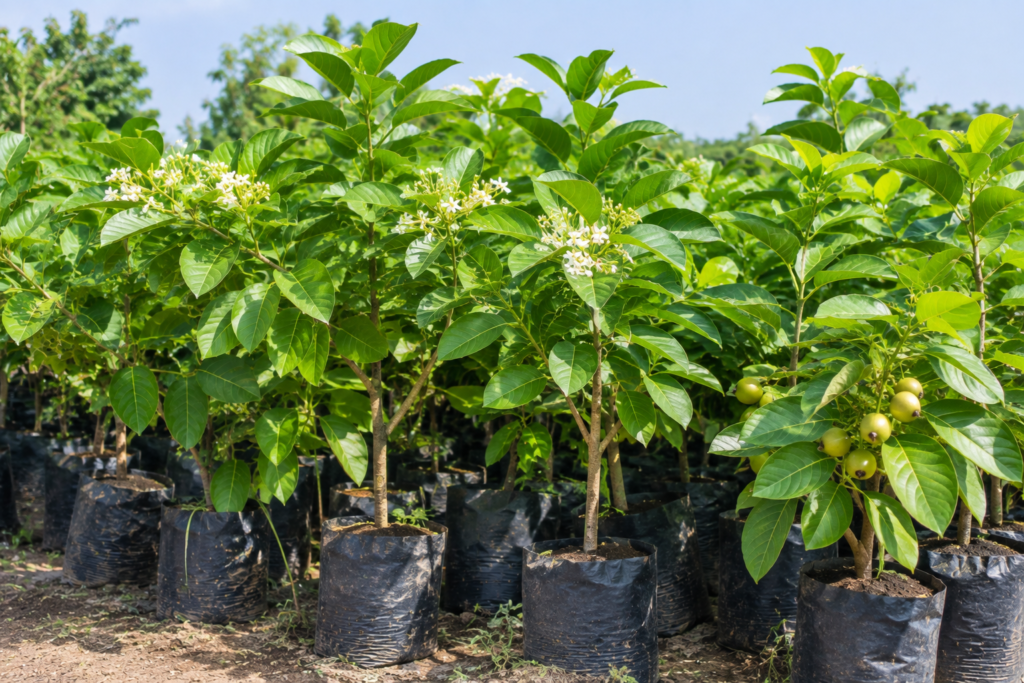
Cordia dichotoma has simple, generally broad leaves and a spreading growth habit. Its flowers are small and white, while its fruits develop from greenish stages and become yellowish as they mature.
The fruit contains a characteristic sticky or mucilaginous pulp. The immature fruits are traditionally used in several Indian cuisines, particularly for pickling and vegetable preparations.
Because of its combination of attractive foliage, fruit production, and adaptability, the tree can have both practical and ornamental value.
How to Grow Cordia Plant in India
1. Choose a Suitable Location
Cordia grows in tropical and subtropical environments, so select a location with adequate sunlight and sufficient open space.
Avoid planting the tree in a location where its future canopy will interfere with buildings, electrical lines, or other large trees.
2. Soil Requirements
Good drainage is important for healthy establishment. Cordia occurs naturally in different soil and forest environments, but a well-drained soil with reasonable fertility can support healthy growth.
Before planting, loosen compacted soil and improve the planting area with suitable organic matter when required.
3. Watering
Newly planted Cordia trees require regular watering during the establishment period. Watering frequency should depend on soil moisture, temperature, rainfall, and local conditions.
Once established, watering can generally be adjusted according to natural rainfall and site conditions. Avoid excessive irrigation in poorly drained soil.
4. Sunlight
A sunny outdoor location is generally appropriate for Cordia. Good light supports active growth and helps the tree develop a healthy canopy.
5. Pruning
Young trees can be trained to develop a balanced structure. Remove damaged, weak, or crossing branches when necessary.
Avoid excessive pruning because it can unnecessarily reduce the natural form of the tree.
Uses of Cordia Plant
Cordia dichotoma has a long history of traditional use in India. Its fruits are used as food and are commonly preserved as pickles in some regions. The species is also reported as a fodder resource.
Various parts of the plant have also been documented in traditional medicine systems. However, traditional use should not be interpreted as proof that Cordia products can treat or prevent a medical condition. Research has investigated its phytochemistry and potential biological activities, but these findings should not replace professional medical advice.
Cordia Plant for Landscaping
Cordia can be considered for selected landscaping situations where a tree with a natural spreading form and additional fruit value is desired.
Potential applications include:
- Farmhouse landscaping
- Large home gardens
- Rural properties
- Orchard-style landscapes
- Institutional green spaces
- Suitable plantation projects
- Biodiversity-focused landscapes
- Boundary and open-area planting
For smaller gardens, consider the mature size and available space before planting.
Cordia Plant for Saharanpur and North India
For locations such as Saharanpur, Nagal, and other parts of North India, plant selection should consider local soil, water availability, sunlight, winter conditions, and the amount of available growing space.
Cordia dichotoma is documented in northern Indian regions and the sub-Himalayan tract, making it a relevant species for North Indian nursery and plantation discussions.
However, local suitability should always be assessed at the planting site rather than assuming that every Cordia plant will perform identically in every location.
Buy Cordia Plants from Anuj Nursery
If you are searching for a Cordia plant in India, selecting a healthy and correctly identified nursery plant is important. Before purchasing, check the botanical name, plant size, root condition, stem health, and quantity required for your project.
Anuj Nursery, located in Nagal, Saharanpur, provides nursery plants and landscaping plant requirements for customers looking for trees and plants for gardens, farms, and larger landscaping projects.
For bulk orders, discuss the required plant quantity, plant size, transportation requirements, and planting location with Anuj Nursery before finalizing your order.
Cordia Plant vs. Cordia Sebestena
A common source of confusion is that the name Cordia plant can refer to different species.
Cordia dichotoma is the Indian species commonly known as Lasora or Indian Cherry. In contrast, Cordia sebestena is known as the Orange Geiger Tree or Scarlet Cordia and is an ornamental species native to tropical America. India Flora Online records Cordia sebestena as an ornamental tree grown in Kerala.
Therefore, when buying a Cordia plant, always confirm the scientific name rather than relying only on the common name.
Frequently Asked Questions
What is the scientific name of the Cordia plant in India?
The commonly referenced Indian Cordia species is Cordia dichotoma G.Forst., commonly known as Lasora or Indian Cherry.
What is Cordia dichotoma called in India?
It is known by several regional names, including Lasora, Lasuda, Gunda, Bhokar, and Indian Cherry.
Is Cordia dichotoma suitable for gardens?
Yes. India Flora Online notes that Cordia dichotoma is sometimes planted in gardens. Its suitability depends on available space, climate, soil drainage, and the intended landscape design.
Are Cordia fruits edible?
Yes. The fruits of Cordia dichotoma are documented as edible and are traditionally used in preparations such as pickles and vegetables.
Where can I buy Cordia plants in India?
Cordia plants can be sourced from plant nurseries and tree suppliers. Buyers should confirm the botanical name and plant quality before purchasing. Anuj Nursery in Nagal, Saharanpur can be considered for nursery and landscaping plant requirements.
Conclusion
The Cordia plant India topic primarily points to Cordia dichotoma, a useful Indian tree known by names such as Lasora, Lasuda, Gunda, and Indian Cherry. Its edible fruits, spreading growth habit, broad Indian distribution, and adaptability make it an interesting choice for suitable gardens, farms, and plantation landscapes.
For successful planting, focus on healthy nursery stock, adequate sunlight, well-drained soil, proper watering during establishment, and sufficient space for future growth. If you are planning a larger planting project, consult Anuj Nursery in Nagal, Saharanpur about plant size, quantity, and project requirements.
AEO Optimization
What is Cordia plant in India?
Cordia plant commonly refers to Cordia dichotoma, a small to medium-sized tree known in India as Lasora, Lasuda, Gunda, Bhokar, and Indian Cherry. It is valued for its edible fruits and traditional uses.
Is Cordia dichotoma good for landscaping?
Cordia dichotoma can be used in suitable gardens, farms, institutional landscapes, and open plantation areas where there is enough space for its spreading growth habit.
Where does Cordia dichotoma grow in India?
It occurs across various parts of India and is associated with tropical and subtropical habitats, including dry deciduous forests and plains.