
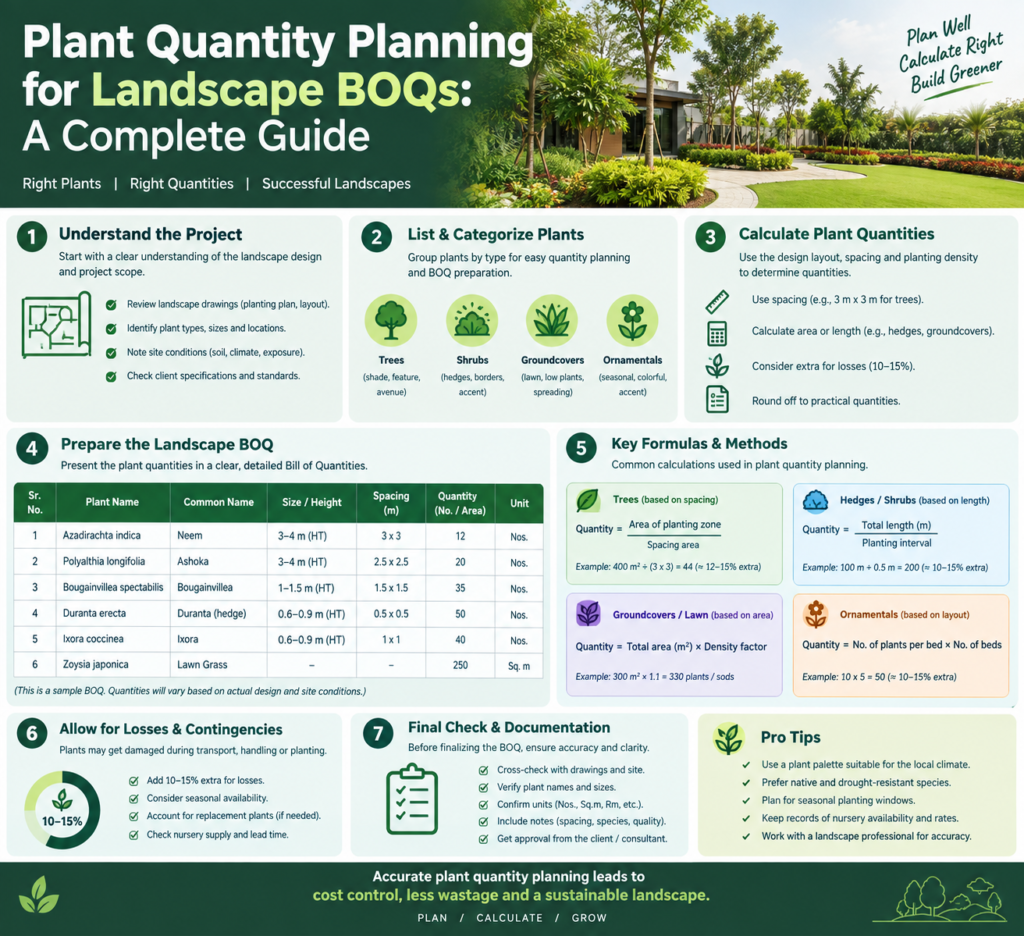
Accurate plant quantity planning is an essential part of every successful landscaping project. Whether the project is a residential garden, commercial property, hotel, resort, highway, institutional campus, or large plantation site, knowing exactly how many plants are required helps control costs and prevents procurement problems.
A Landscape BOQ (Bill of Quantities) provides a structured list of materials, plants, quantities, specifications, and other requirements needed to complete a project. Proper plant quantity planning ensures that the landscape design can be implemented according to the approved plan without unnecessary shortages or excess stock.
For landscape contractors, designers, developers, and property owners, understanding how to prepare plant quantities can make procurement easier and more efficient.
What Is a Landscape BOQ?
A Landscape BOQ is a detailed document used to estimate and manage the materials and work required for a landscaping project. It may include trees, shrubs, palms, groundcovers, flowering plants, climbers, lawns, soil, irrigation materials, hardscape elements, and maintenance requirements.
For plants, a BOQ generally includes:
- Plant name and botanical name
- Plant category
- Required quantity
- Plant size
- Pot or bag size
- Spacing requirements
- Location or planting zone
- Rate per plant
- Total estimated cost
- Special specifications
A well-prepared BOQ becomes a useful reference for procurement, budgeting, execution, and project monitoring.
Why Accurate Plant Quantity Planning Matters
Incorrect plant quantities can create several problems. If too few plants are ordered, the project may face delays while additional stock is arranged. If too many plants are purchased, money may be unnecessarily tied up in surplus material.
Accurate planning helps with:
Budget control: Quantity estimates provide a clearer picture of plant procurement costs.
Procurement: Nurseries can prepare the required plant stock in advance.
Project scheduling: Correct quantities make planting operations easier to organise.
Design consistency: Proper quantities help maintain the intended spacing and visual balance.
Waste reduction: Over-ordering can be reduced when calculations are carefully prepared.
How to Calculate Plant Quantities
The calculation method depends on the type of planting area and the design requirements.
1. Measure the Planting Area
Start by measuring the length and width of the planting zone. For rectangular areas, multiply length by width to determine the approximate area.
For irregular landscape beds, divide the area into smaller sections and calculate each section separately.
2. Determine Plant Spacing
Plant spacing is one of the most important factors in quantity calculation. For example, shrubs planted at closer intervals will require more plants than shrubs planted at wider intervals.
The appropriate spacing depends on:
- Mature plant size
- Growth habit
- Landscape purpose
- Desired visual density
- Maintenance requirements
- Plant species
Avoid calculating quantities only from the current nursery size. Mature growth should always be considered.
3. Calculate the Number of Plants
For a simple planting bed, divide the planting area by the approximate area allocated to each plant.
For example, if a 100-square-metre bed is designed with plants at approximately 1 metre × 1 metre spacing, the basic calculation would be around 100 plants before allowing for design adjustments.
Actual quantities should be refined according to the landscape drawing, planting pattern, edges, curves, and site conditions.
Consider Plant Categories Separately
Different plant categories require different calculation approaches.
Trees: Quantities are usually based on specific planting locations, spacing, canopy requirements, and site dimensions.
Shrubs: Quantities depend heavily on spacing and whether the plants are being used for mass planting, borders, hedges, or decorative groups.
Groundcovers: These often require higher quantities because they are planted at relatively close spacing to achieve coverage.
Palms: Their quantity depends on focal-point placement, avenue spacing, building surroundings, and landscape composition.
Flowering plants: Seasonal displays may require quantities based on bed area, colour combinations, and replacement cycles.
Separating categories makes the BOQ easier to review and reduces calculation errors.
Include an Allowance for Plant Replacement
Landscape projects may experience minor losses during transportation, handling, planting, or establishment. Depending on the project specifications, a reasonable replacement allowance may be considered.
However, additional plants should not be added randomly. The allowance should be clearly documented so the client, contractor, designer, and supplier understand the reason for the additional quantity.
Verify Quantities Before Procurement
Before placing a large plant order, compare the BOQ with the latest landscape drawings. Design revisions can change plant quantities, locations, or specifications.
Check:
- Latest approved landscape plan
- Plant schedule
- Plant spacing
- Plant sizes
- Quantity by zone
- Site measurements
- Availability
- Delivery requirements
This final verification can prevent expensive procurement mistakes.
Plant Quantity Planning With Anuj Nursery
Anuj Nursery can be a useful plant sourcing partner for landscaping projects requiring planned quantities of trees, shrubs, palms, flowering plants, and other landscape plants.
For projects in and around Nagal and Saharanpur, working with a local nursery can make plant availability, quantity coordination, inspection, and transportation easier. Providing the plant schedule or BOQ in advance can also help the nursery understand the project’s requirements and prepare suitable stock.
For larger commercial landscaping and plantation projects, early coordination is particularly important because large quantities of the same plant may require advance planning.
Common Mistakes in Landscape BOQ Plant Planning
Some common mistakes include:
- Using outdated landscape drawings
- Ignoring plant spacing
- Calculating only by nursery size
- Forgetting planting zones
- Mixing different plant sizes in one quantity
- Not checking nursery availability
- Over-ordering without justification
- Failing to account for design changes
- Not verifying quantities before delivery
Avoiding these mistakes can improve both project efficiency and budget control.
AEO: Frequently Asked Questions
What is plant quantity planning in a landscape BOQ?
Plant quantity planning is the process of calculating the number of trees, shrubs, palms, groundcovers, and other plants required for a landscaping project based on design, spacing, area, and specifications.
How do you calculate plants for a landscape project?
Measure the planting area, determine suitable plant spacing, calculate the approximate number of plants, and then adjust the quantity according to the landscape design and site conditions.
Why is a Landscape BOQ important?
A Landscape BOQ helps organise plant quantities, specifications, costs, and procurement requirements, making project planning and budget management easier.
Should extra plants be included in a BOQ?
A suitable replacement allowance may be included when project specifications permit it. The allowance should be clearly documented rather than added without calculation.
GEO: Plant Quantity Planning in Saharanpur
For landscaping projects in Saharanpur, Nagal, and nearby areas, plant quantity planning should consider local climate, soil conditions, irrigation availability, seasonal planting requirements, plant availability, and transportation. Local sourcing through a nursery such as Anuj Nursery can help coordinate plant quantities and procurement for residential, commercial, institutional, and larger landscape projects.
Conclusion
Accurate plant quantity planning for landscape BOQs helps turn a landscape design into an organised and manageable project. By measuring planting areas carefully, calculating appropriate spacing, separating plant categories, checking the latest drawings, and coordinating with a reliable nursery, project teams can reduce shortages, avoid unnecessary purchases, and maintain design consistency.
A detailed BOQ is more than a quantity list. It is a practical planning tool that connects landscape design, budgeting, procurement, and site execution. Early coordination with Anuj Nursery can further support smooth plant sourcing for landscaping projects in Saharanpur, Nagal, and other parts of North India.