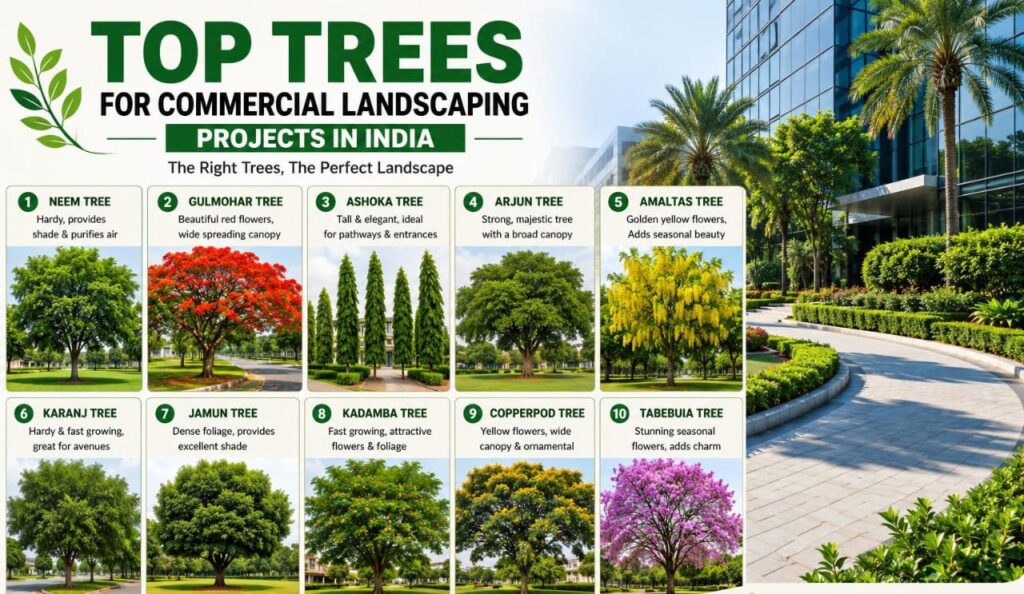
Commercial landscaping is more than simply adding greenery to a property. The right trees can transform corporate offices, hotels, resorts, malls, institutions, residential townships, parks, and roadside areas into attractive, comfortable, and welcoming spaces. In India, tree selection should consider climate, soil, available space, water requirements, maintenance, canopy size, and the overall landscape design.
If you are planning a commercial landscaping project, choosing the right species from the beginning can improve the appearance and long-term performance of the landscape. Here are some of the top trees for commercial landscaping projects in India.
1. Neem Tree
Neem is one of the most reliable trees for Indian landscapes. It is hardy, provides good shade, and can perform well in warm and relatively dry conditions. Neem is suitable for large campuses, parking areas, roadsides, parks, institutional properties, and greenbelt plantations.
Its dense foliage makes it a practical choice where shade and greenery are important.
2. Gulmohar Tree
Gulmohar is one of the most popular flowering trees used in Indian landscaping. Its broad canopy and striking red-orange flowers create an impressive visual effect.
It is particularly suitable for avenues, parks, resorts, hotel landscapes, and large gardens where seasonal colour is desired. However, adequate space should be provided for its mature canopy.
3. Ashoka Tree
Ashoka, especially the commonly planted columnar form, is an excellent option for formal commercial landscapes. Its tall and narrow growth makes it useful where planting space is limited.
It works beautifully along entrances, pathways, boundaries, office buildings, hotels, and institutional campuses. Its vertical form also creates a neat and structured appearance.
4. Arjun Tree
Arjun is a large Indian tree with a spreading canopy and strong landscape value. It can be considered for spacious commercial properties, parks, campuses, and suitable avenue plantations.
Because mature trees need sufficient room, Arjun should be selected according to the site’s available soil volume and planting space. Government landscape references also include Arjun among major avenue tree choices.
5. Amaltas Tree
Amaltas is an excellent choice for adding seasonal colour to commercial landscapes. Its attractive yellow flowers can create a beautiful display, especially during the warmer months.
It is suitable for parks, resorts, institutional campuses, avenues, and garden areas. Amaltas can be combined with evergreen trees and shrubs to create a balanced landscape design.
6. Karanj Tree
Karanj is a hardy tree that can be useful for larger landscape and plantation projects. It provides shade and has dense foliage, making it suitable for selected avenues, campuses, greenbelts, and open areas.
It is particularly useful when landscape planners want a functional tree rather than relying only on ornamental species.
7. Jamun Tree
Jamun is a dense evergreen Indian tree that can provide substantial shade. It is suitable for large gardens, campuses, parks, and other spacious properties.
However, because its fruit can stain paved surfaces, planting location should be planned carefully around building entrances, walkways, and parking areas.
8. Kadamba Tree
Kadamba is valued for its fast growth, attractive foliage, and distinctive flowers. It can add a tropical character to large landscapes and works well in spacious gardens, resorts, institutional campuses, and green areas.
It can be particularly attractive when used as a feature tree or as part of a mixed plantation design.
9. Copperpod Tree
Copperpod, also known as Peltophorum, is valued for its attractive yellow flowers and broad canopy. It can be used for avenues, commercial campuses, parks, and large outdoor areas where sufficient space is available.
Its flowering display can add strong seasonal interest to an otherwise green landscape.
10. Tabebuia
Tabebuia is increasingly popular in ornamental landscaping because of its attractive seasonal flowering. Depending on the species and local conditions, the flowers can provide a striking display along roads, pathways, campuses, and commercial properties.
It is a good option when the goal is to combine shade, structure, and strong visual appeal.
How to Choose the Right Trees for Commercial Landscaping?
Selecting a tree should not be based only on its appearance. Consider the following factors before planting:
- Available space: Check the mature height and canopy spread.
- Root behaviour: Avoid placing large-rooted species too close to foundations, pavements, and underground utilities.
- Climate: Choose species suitable for the local temperature and rainfall.
- Water availability: Select plants according to the irrigation capacity of the property.
- Maintenance: Consider pruning, leaf litter, pest management, and seasonal care.
- Purpose: Decide whether you need shade, screening, flowering, avenue planting, or a feature tree.
- Planting distance: Provide sufficient space for healthy long-term growth.
For roadside and avenue projects, mature canopy, root behaviour, clearance, and available soil volume are particularly important considerations.
Why Trees Matter in Commercial Landscaping
Well-planned trees can improve the overall character of a commercial property while creating more comfortable outdoor areas. Trees can provide shade, define pathways, create visual screens, soften large buildings, and contribute to greener surroundings.
For large projects, a combination of evergreen, flowering, shade, and ornamental trees often produces a more attractive result than planting only one species throughout the property.
Buy Quality Landscaping Trees from Anuj Nursery
Choosing healthy, well-established planting material is an important part of a successful commercial landscaping project. Anuj Nursery can be a reliable source for landscaping trees and plants for projects requiring greenery at scale.
Whether you are developing a corporate campus, hotel, resort, residential township, park, institutional property, or commercial landscape, selecting the right trees according to site conditions can help create a beautiful and sustainable outdoor environment.
Frequently Asked Questions
Which trees are best for commercial landscaping in India?
Neem, Gulmohar, Ashoka, Arjun, Amaltas, Karanj, Jamun, Kadamba, Copperpod, and Tabebuia are popular options for different commercial landscaping applications.
Which tree is best for an office campus?
Ashoka, Neem, Gulmohar, Amaltas, and selected ornamental trees can work well for office campuses, depending on available space, climate, and design requirements.
What should I consider before planting trees near buildings?
Consider mature canopy size, root behaviour, overhead clearance, underground utilities, drainage, and the required maintenance access.
How can I select trees for a large landscaping project?
Start by assessing the project’s climate, soil, sunlight, irrigation, available planting space, landscape design, and maintenance budget. Then select species according to their mature characteristics.
Final Thoughts
The success of a commercial landscaping project depends greatly on selecting trees that are suitable for both the design and the site. From hardy Neem and elegant Ashoka to colourful Gulmohar and Amaltas, India offers many excellent choices for commercial landscapes.
With proper planning, quality planting material, adequate spacing, and regular maintenance, the right trees can create greener, more attractive, and long-lasting commercial outdoor spaces.