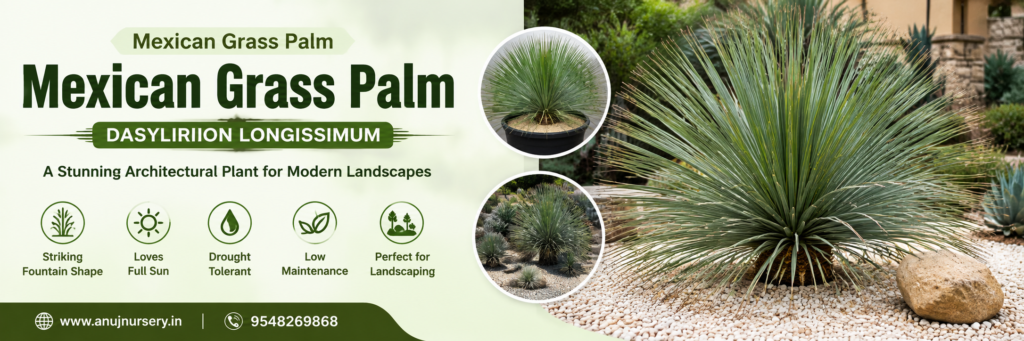
The Mexican Grass Palm Dasylirion longissimum is a striking architectural plant known for its long, narrow, grass-like leaves and symmetrical fountain-shaped appearance. Despite its common name, it is not a true palm. It belongs to the Asparagaceae family and is closely associated with the group of plants commonly called sotols.
With its dramatic form and evergreen foliage, Dasylirion longissimum is increasingly attractive for modern gardens, resorts, commercial landscapes, rock gardens, courtyards, and low-water landscaping. Its sculptural appearance allows it to stand out even when surrounded by simple hardscape elements such as gravel, stone, concrete, or pathways.
What Is Dasylirion Longissimum?
Dasylirion longissimum is a perennial, evergreen plant native to Mexico. It develops a dense rosette of extremely narrow leaves that radiate outward and create a graceful, fountain-like form.
The leaves can give the plant an almost grass-like appearance, which explains the popular name Mexican Grass Palm. However, calling it a palm is botanically inaccurate. Understanding this distinction is useful when searching for or purchasing the plant.
Its unusual shape makes it particularly valuable as an architectural landscape specimen.
Key Features of Mexican Grass Palm
1. Unique Fountain-Shaped Foliage
The narrow leaves emerge from the center and spread outward, creating a symmetrical fountain effect. This gives the plant a strong ornamental presence.
2. Evergreen Appearance
In suitable growing conditions, Dasylirion longissimum maintains its foliage throughout the year, providing consistent landscape interest.
3. Drought-Tolerant Characteristics
As a plant adapted to relatively dry environments, it can tolerate periods of limited water once established. However, newly planted specimens still require appropriate watering.
4. Low-Maintenance Landscaping Option
Once properly established in suitable soil and climate conditions, the plant generally requires less routine care than many high-water landscape plants.
5. Excellent Architectural Plant
Its geometric form works particularly well in contemporary, minimalist, desert and Mediterranean-inspired landscapes.
How to Plant Dasylirion Longissimum
Choose a location with plenty of sunlight and excellent drainage. Dasylirion longissimum does not perform well when its roots remain in continuously wet soil.
Prepare a planting hole wider than the root ball and ensure that water can drain away efficiently. Carefully place the plant at approximately the same depth at which it was growing in its nursery container.
After planting, water thoroughly. During the establishment period, provide irrigation according to soil moisture and weather conditions. Once established, allow the soil to dry appropriately between watering sessions.
Avoid planting it in locations where heavy rain or irrigation regularly creates standing water.
Mexican Grass Palm Care Guide
Sunlight
Full sun is generally ideal for developing strong, attractive foliage. Choose an open location with plenty of natural light.
Watering
Young plants need regular watering while their roots establish. Mature plants can generally tolerate drier conditions, but watering should still be adjusted according to local climate and soil.
Overwatering is a common mistake. The plant’s drought tolerance does not mean it should be kept constantly dry during establishment.
Soil
Well-drained soil is essential. Sandy, gritty or otherwise freely draining soil can be particularly suitable.
Fertilization
A moderate application of suitable fertilizer during the active growing period can support healthy development. Excessive fertilizer is unnecessary.
Pruning
Remove dry or damaged leaves when required. Avoid excessive pruning because the natural fountain shape is one of the plant’s most attractive features.
Landscaping Uses of Dasylirion Longissimum
The Mexican Grass Palm can be used in many landscape designs, including:
- Modern residential gardens
- Rock gardens
- Xeriscape landscapes
- Desert-style gardens
- Resort landscaping
- Commercial properties
- Courtyards
- Driveway borders
- Entrance landscaping
- Poolside landscapes where suitable
- Large decorative containers
- Architectural landscape projects
It looks especially effective when planted against gravel, stone walls, pathways, or modern buildings.
Mexican Grass Palm in India
Dasylirion longissimum can be an interesting choice for Indian landscaping where its requirements can be met. It generally benefits from strong sunlight and well-drained soil.
The biggest consideration for Indian gardeners is drainage. In regions receiving heavy monsoon rainfall, planting the Mexican Grass Palm in a raised or exceptionally well-drained location may be necessary.
Before large-scale planting, evaluate local rainfall, soil type, winter temperatures and irrigation conditions.
Frequently Asked Questions
Is Dasylirion longissimum a palm?
No. Despite the common name Mexican Grass Palm, Dasylirion longissimum is not a true palm. It is an architectural perennial related to the sotol group.
Is Mexican Grass Palm drought tolerant?
Yes. Once established, Dasylirion longissimum can tolerate relatively dry conditions. However, young plants require appropriate watering.
Does Dasylirion longissimum need full sun?
It generally performs best in a sunny, open location with good light.
Is Mexican Grass Palm suitable for small gardens?
Yes, it can be used as a specimen plant in smaller landscapes, provided there is enough room for the mature rosette and its long leaves.
How often should Mexican Grass Palm be watered?
Watering depends on climate, soil and plant age. Newly planted specimens need more frequent irrigation, while established plants generally require less frequent watering. Avoid permanently wet soil.
Buy Mexican Grass Palm from Anuj Nursery
If you are looking for a distinctive architectural plant for a modern garden, rock landscape, resort, farmhouse or commercial project, Dasylirion longissimum Mexican Grass Palm can be an excellent choice.
Anuj Nursery provides ornamental plants and landscaping plants for residential, commercial and large-scale landscape requirements.
Website: anujnursery.in
Contact: 9548269868
Conclusion
The Mexican Grass Palm Dasylirion longissimum is a visually striking, evergreen architectural plant that brings a modern and sculptural character to landscapes. Its narrow fountain-like leaves, drought-tolerant characteristics and relatively low-maintenance nature make it an attractive option for rock gardens, xeriscapes, contemporary landscapes and decorative planting.
For successful growth, focus on the fundamentals: plenty of sunlight, excellent drainage, careful watering and adequate planting space. Do not make the common mistake of treating it like a traditional palm or overwatering it. With the right conditions, Dasylirion longissimum can become a distinctive long-term feature of your landscape.