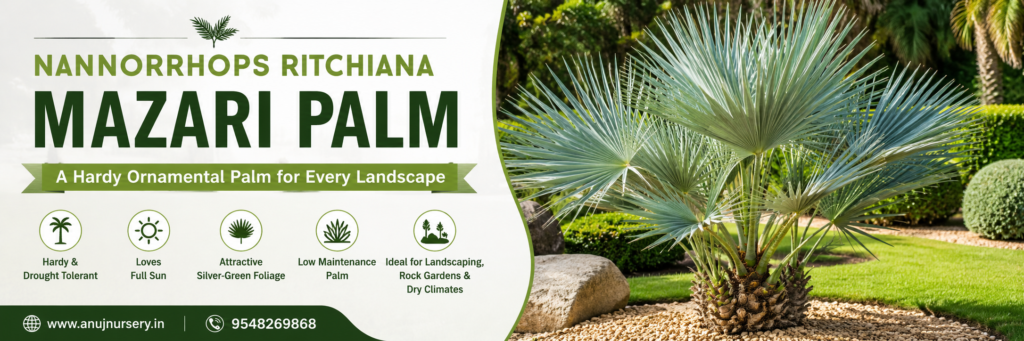
The Nannorrhops Ritchiana Mazari Palm, commonly known as Mazari Palm, is a distinctive ornamental palm valued for its attractive silvery-green foliage, rugged appearance, and ability to tolerate challenging growing conditions. Scientifically known as Nannorrhops ritchiana, this palm is native to dry regions of South and Southwest Asia and is naturally adapted to heat, drought, and relatively harsh environments.
Unlike many traditional palms that develop a tall, single trunk, Mazari Palm can have a clumping or low-growing form. This makes it an interesting choice for rock gardens, dry landscapes, courtyards, borders, desert-style gardens, and modern landscaping projects.
What Is Nannorrhops Ritchiana?
Nannorrhops ritchiana belongs to the palm family Arecaceae. It is recognized for its fan-shaped leaves, which can have an attractive blue-green or silvery appearance.
The palm has a naturally rugged character and can provide strong visual contrast when planted alongside green foliage plants, ornamental grasses, rocks, pathways, and architectural landscape elements.
Its natural adaptation to dry climates makes it particularly interesting for gardeners looking for an ornamental palm that can perform well with comparatively low water requirements once established.
Key Features of Mazari Palm
1. Attractive Silver-Green Foliage
The fan-shaped leaves are one of the strongest ornamental features of Mazari Palm. Their silvery coloration can add a sophisticated appearance to gardens and landscape designs.
2. Hardy Nature
Mazari Palm is adapted to relatively harsh and dry environments. With suitable planting conditions, it can tolerate heat and periods of limited water.
3. Drought-Tolerant Characteristics
Once established, this palm can be relatively water-efficient compared with many landscape plants. However, drought tolerance does not mean that newly planted palms should be neglected.
4. Unique Landscape Form
Its clumping or low-growing growth habit gives it a different appearance from tall, single-trunk palms.
5. Excellent Ornamental Value
The combination of fan-shaped foliage, silver-green color, and rugged structure makes it suitable for contemporary and dry-climate landscape designs.
How to Plant Mazari Palm
Choose an open location with plenty of sunlight and good soil drainage. Mazari Palm is not a good candidate for areas where water remains around the roots for long periods.
Prepare a planting hole that is wider than the root ball. Carefully place the nursery plant at approximately the same depth at which it was growing in its container.
Backfill with suitable soil and water thoroughly after planting. During the establishment period, monitor soil moisture and provide irrigation when required.
For multiple palms, provide adequate spacing according to the expected mature size and landscape design. Avoid overcrowding plants simply to create an instant dense appearance.
Mazari Palm Care Guide
Sunlight
Mazari Palm generally prefers a sunny location. Good light supports healthy foliage development and helps maintain its characteristic appearance.
Watering
Young plants need regular watering while establishing their root systems. After establishment, watering can usually be reduced depending on climate, soil and rainfall.
The key is to avoid overwatering. Well-drained soil is more important than keeping the soil constantly wet.
Soil
Use well-drained soil. Sandy or gritty soil can be suitable where it allows excess water to drain efficiently. Heavy compacted soil should be improved before planting.
Fertilization
A suitable palm fertilizer can be applied according to soil conditions and local recommendations. Avoid excessive fertilizer application.
Pruning
Remove dead or damaged leaves when necessary. Avoid excessive removal of healthy green fronds because they contribute to the palm’s overall health and appearance.
Landscaping Uses of Nannorrhops Ritchiana
Mazari Palm can be used in a variety of landscape designs, including:
- Xeriscape gardens
- Rock gardens
- Desert-style landscapes
- Modern residential gardens
- Commercial landscaping
- Resort landscapes
- Courtyards
- Garden borders
- Driveway landscaping
- Palm collections
- Dry-climate gardens
- Container or architectural landscape settings where appropriate
Its silver-green foliage works particularly well with darker green plants and hardscape materials such as stone, gravel and concrete.
Mazari Palm in India
The Mazari Palm can be an interesting choice for Indian landscapes, particularly in regions where its preference for warm, sunny and well-drained conditions can be accommodated.
However, gardeners should not assume that every dry or hot location is automatically ideal. Soil drainage, winter temperatures, rainfall patterns and irrigation practices all influence performance.
Before large-scale planting, evaluate the local site conditions and choose healthy nursery-grown plants.
Frequently Asked Questions About Mazari Palm
What is the scientific name of Mazari Palm?
The scientific name is Nannorrhops ritchiana.
Is Mazari Palm drought tolerant?
Yes, it is adapted to dry environments and can tolerate periods of limited water once established, provided it is planted in suitable soil.
Does Mazari Palm need full sun?
It generally performs best in a sunny location with good light.
Is Mazari Palm suitable for landscaping?
Yes. Its silver-green fan foliage and distinctive form make it an attractive ornamental palm for dry, modern and architectural landscapes.
Does Mazari Palm grow into a tall palm tree?
Unlike many classic tall palms, Nannorrhops ritchiana can have a lower, clumping growth habit. Its mature form depends on growing conditions and the individual plant.
Buy Mazari Palm from Anuj Nursery
If you are searching for a Mazari Palm plant for a dry garden, modern landscape, rock garden, resort or ornamental planting project, Nannorrhops ritchiana is a distinctive option.
Anuj Nursery offers plants for ornamental gardening, landscaping and plantation requirements.
Website: anujnursery.in
Contact: 9548269868
Conclusion
The Nannorrhops Ritchiana Mazari Palm is an excellent ornamental choice for gardeners who want something different from conventional tall palms. Its silvery fan-shaped foliage, rugged appearance, drought-tolerant characteristics and adaptability to dry landscapes make it particularly valuable for modern and low-water landscaping.
For the best results, provide plenty of sunlight, excellent drainage, appropriate watering and enough space for the plant to develop naturally. Most importantly, remember that drought tolerant does not mean maintenance-free—proper establishment care is essential for a healthy Mazari Palm.